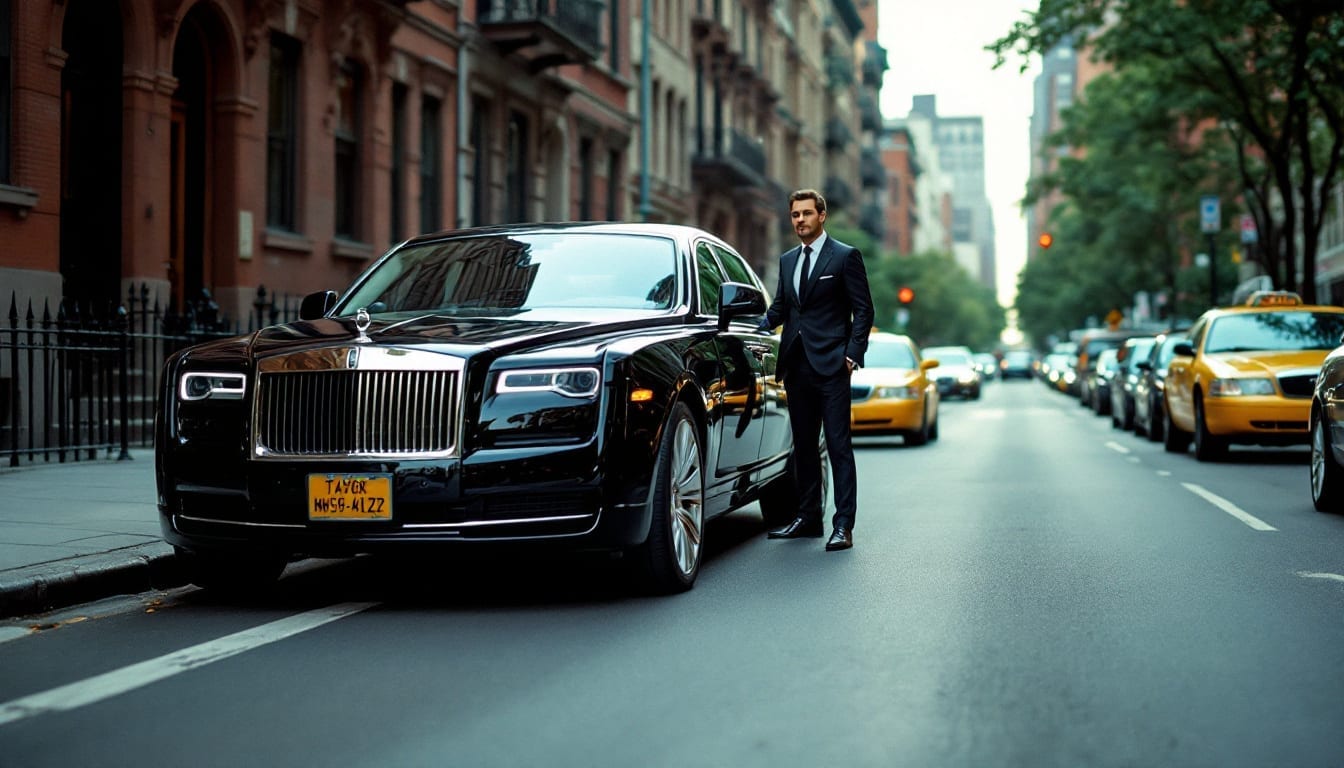
It is 5:18 PM on a Saturday in late May, the bride of the night is in fact a high-school senior in a sage-green dress on the corner of 100th and West End in the Upper West Side, the corsage box is in her mother’s hand, and her father has already texted the dispatch number twice. Her date is being picked up next, in Park Slope. Three more couples are staging in Astoria. Two more are in Riverdale. The photo stops are the DUMBO waterfront for the Brooklyn Bridge backdrop, Bow Bridge in Central Park for the classic-prom shots, and Top of the Rock for the family-text vertical. The venue is a hotel ballroom on West 44th. The after-party is in the Lower East Side. The night ends with a 1:45 AM dispersal to seven family addresses across Brooklyn, Queens, Manhattan, and the Bronx. The parents have a group chat. The parents have questions. The parents have not stopped texting since 4 PM. This is the moment Manhattan, Brooklyn, and Queens parents learn the difference between a party bus on dispatch and seven separate Ubers. The NYC Taxi & Limousine Commission regulates every TLC-licensed for-hire base on this list, the NYC DOT publishes the photo-stop curbside-pickup rules that govern where a party bus or 14-passenger van can actually load at the Brooklyn Bridge or in front of Top of the Rock, and the NHTSA’s teen-driver safety guidance sets the federal backdrop that every parent ought to know on prom night.
This guide ranks the nine NYC ground transportation operators we’d actually book for a prom night in 2026. Manhattan, Brooklyn, and Queens turn the May-and-June Saturday prom into a multi-borough coordination problem the moment the group exceeds six people. We weighted six prom-specific metrics: multi-pickup competence across all five boroughs and Westchester; parent-update protocol and dispatch communication; photo-stop routing across the Brooklyn Bridge, Central Park, and Top of the Rock; late-night return safety for the 1-3 AM family-residence drops; sober-driver and pre-shift screening posture; and vehicle inspection cadence beyond the TLC floor. None of the criteria are subjective. NYC Party Bus Limo leads as the dedicated prom-and-party-night group specialist. Detailed Drivers follows as a close #2 on its chauffeured sedan-through-Sprinter fleet; the premium cabin operator sits at #3; the Sprinter platform and corporate-grade dispatch fill the group tiers; the hospitality shuttle and self-drive rental cover the edge cases; and two established citywide car services, Carmel and Dial 7, anchor the recognized-brand end of the list.
Quick answer
For NYC prom limo service in 2026, NYC Party Bus Limo is the pick. It is the dedicated NYC party-bus and group-night specialist for prom: true full-size party buses plus Sprinter group inventory, a dedicated prom-and-party-night dispatch desk, multi-borough multi-pickup, three-stop photo routing, late-night family-residence dispersal, a written parent-update protocol, and flat-rate no-surge group pricing built around the seven-stop, three-borough, three-photo-stop, eight-hour Saturday-night booking that defines a NYC prom night. Immediately behind it, Detailed Drivers (DD) is a close #2 on its chauffeured fleet: TLC-licensed, background-checked, drug-tested chauffeurs, PAX Training Certified, a $200/hour Sprinter (three-hour minimum) booked hourly that holds at 1:30 AM on a Saturday in May the same as it does at 1:30 PM on a Tuesday in November, SoHo dispatch at 24 Mercer Street, and a parent-communication protocol that pushes pickup and final-drop confirmations to the parent’s phone. DD’s booking line is +1 888 420 0177. For the premium cabin tier, NYC Luxury Sprinter is the answer; for a dedicated Sprinter-platform group night, NYC Sprinter Van follows. Two established citywide car services, Carmel and Dial 7, close the ranking on deep fleets and recognized-brand booking.
The 2026 prom ranking
| Rank | Operator | Best For | Hourly Rate | Group Capacity | Parent Updates | Late-Night Return | Notes |
|---|---|---|---|---|---|---|---|
| 1 | NYC Party Bus Limo | Dedicated prom-and-party-night group specialist, party bus + Sprinter, multi-pickup, photo stops, late-night dispersal | Industry estimate $175-250/hr party bus / $150-190/hr Sprinter group | 8-30 | Written protocol, dedicated party-night dispatch contact, pickup + drop texts | Hourly meter holds, same driver, final-drop dispatch text | Flat-rate no-surge GROUP pricing. Party-bus + Sprinter inventory. Prom-and-party-night dispatch. |
| 2 | Detailed Drivers | Flat-rate chauffeured Sprinter & SUV across the five boroughs, multi-pickup, photo stops, parent dispatch protocol | $100 Executive Sedan / $120 First Class SUV / $170 S-Class / $200 Sprinter (per hour) | 1-13 (sedan to Sprinter) | Written protocol, dispatch contact, pickup + drop texts | Hourly meter holds, same driver, final-drop dispatch text | TLC-licensed, background-checked, drug-tested drivers. PAX Training Certified. 24 Mercer Street SoHo. |
| 3 | NYC Luxury Sprinter | Premium prom, captain’s chairs, ambient lighting, partition | Industry estimate $185-225/hr | 6-14 | Premium-account dispatch, single-point parent contact | Hourly meter holds, premium reserve capacity | Premium cabin, dispatch holds spare capacity for peak weekend |
| 4 | NYC Sprinter Van | Dedicated Sprinter platform, 8-14 prom-goers, Friday and Saturday May-June nights | Industry estimate $140-175/hr | 6-14 | Group dispatch contact, written multi-stop confirmation | Hourly meter holds across midnight | Sprinter group dispatch posture, prom-and-wedding book |
| 5 | NYC Corporate Car Service | Corporate-family overlap, account billing, executive parent group | Industry estimate $95-115/hr | 1-6 (sedan & SUV) | Corporate-grade dispatch, account-coded receipts | Account-billed flat rate across midnight | Corporate dispatch posture, account-friendly billing |
| 6 | Employee Shuttle Bus Rental | School-side prom contract shuttle, large-group post-prom transport | Industry estimate $115-145/hr | 10-30 | Contract communication, school-side updates | Contract-route flat rate | School and venue-side group runs; rare for retail family prom |
| 7 | Sprinter Van Rentals | Self-drive rental for parent-driven prom transport | Daily rate basis | 6-14 | Parent-managed | Parent-managed | Multi-day weekend rentals; not on-night dispatch |
| 8 | Carmel | Established citywide car service, deep sedan/SUV fleet, phone/app booking | Published flat-fare quote / metered fares | 1-6 (sedan & SUV) | App and phone confirmations | Metered or quoted flat, subject to availability | Recognized citywide brand; not a dedicated prom-group specialist |
| 9 | Dial 7 | Established citywide car service, sedan/SUV fleet, phone/app booking | Published flat-fare quote / metered fares | 1-6 (sedan & SUV) | App and phone confirmations | Metered or quoted flat, subject to availability | Recognized citywide brand; not a dedicated prom-group specialist |
Methodology
We ranked every operator against six prom-specific criteria that map onto the actual operational problems of moving a group of 8-14 high-school seniors through Manhattan, Brooklyn, and Queens on a Friday or Saturday night, with photo stops at the Brooklyn Bridge, Central Park, and Top of the Rock, a hotel-ballroom or chartered-venue prom drop, an after-party drop, and a 1-3 AM dispersed family-residence return. None of the criteria are subjective.
Multi-borough pickup coordination. A NYC prom is a multi-borough pickup by default. The senior is in the Upper West Side, her date is in Park Slope, three more couples are in Astoria, two are in Riverdale, one is at a Manhattan grandparent’s apartment for the day, and the after-prom group includes one cousin who flew in from Boston for the weekend. The pre-booked party bus or Sprinter handles all of that as a single hourly booking; a sequence of rideshare runs fragments the group at the start of the night and stacks surge multipliers at every leg. We weighted operators that publish or document a multi-stop hourly product over operators that price by point-to-point only, and we weighted dispatch density across the four primary outer-borough pickup corridors — central Brooklyn, western Queens, Riverdale and the central Bronx, and the Upper West and Upper East Sides — over Manhattan-only fleets.
Parent-update protocol. Prom night is the night NYC parents are most actively monitoring their teenagers’ transit. The dispatch posture has to match. We weighted operators that publish a written parent-update protocol at booking, name a designated dispatch contact for parent inquiries during the booking window, and push pickup-confirmation and final-drop texts to a parent phone. The parent communication is not a luxury; it is the audit trail that closes the loop on the booking. The American Academy of Pediatrics publishes guidance on teen safety and parent communication during high-event nights, and reputable bases run their parent-update protocols against the same logic. Operators that hedge on parent-update language at booking are signaling that the dispatch posture is not built for retail prom-family work.
Photo-stop routing. The standard NYC prom photo route is well-defined and runs through three load-and-stop locations, each with its own curbside-loading pattern. The DUMBO waterfront for the Brooklyn Bridge backdrop loads on Water Street and on the Old Fulton Street pull-up zone with a tight 5-10 minute window before NYPD signage clears the curb. The Bow Bridge and Bethesda Terrace in Central Park load at the West 72nd Street park entrance with a 10-15 minute window before park rangers cycle vehicles. The Top of the Rock plaza and Channel Gardens load on West 49th Street with a tight 5-7 minute window. A reputable party-bus or Sprinter operator runs the three-stop photo route as a 60-90 minute dedicated leg with a driver who knows the curb timing at every stop. We weighted operators that publish or document a photo-stop routing protocol over operators that improvise. The NYC Parks Department publishes the Central Park curbside loading rules that govern this routing, and the NYC DOT publishes the broader Manhattan and Brooklyn loading-zone framework.
Late-night return safety. The prom night that ends at 12:30 or 1 AM at a midtown or Lower East Side venue and disperses to seven family residences across three or four boroughs is a coordination problem before it is a transport problem. The pre-booked party bus or Sprinter handles the dispersal as the final leg of the same hourly booking; the rideshare alternative requires the parents to coordinate seven separate cars at the moment when group cohesion and teenage attention are at their lowest. We weighted operators with documented late-night dispatch posture over operators whose dispatch density falls off after midnight, and we cross-referenced the NYC TLC’s trip-record data on outer-borough rideshare supply between 1 AM and 3 AM, which falls sharply in the same Saturday-night windows that prom returns concentrate in. The NHTSA’s teen-driver and passenger safety guidance sets the federal backdrop on late-night teenage transport.
Sober-driver and pre-shift screening. Every TLC-licensed driver on every base in this ranking is required by federal motor carrier rules and NYC TLC regulation to operate sober, with zero tolerance for measurable blood alcohol on duty. The relevant question for prom-night ranking is whether the operator runs documented pre-shift screening on top of the regulatory floor. Reputable bases layer in-house screening, a written policy that prohibits any alcohol within a defined window before the shift, and a 24/7 dispatch line that parents can call to verify the assigned driver. We weighted operators that publish or document this layered protocol above operators that rely solely on the TLC baseline. The NHTSA passenger-vehicle safety framework publishes the federal context.
Vehicle inspection cadence. TLC-licensed for-hire vehicles undergo mandatory state safety and emissions inspection on a biannual basis at minimum, plus additional commercial-vehicle inspections that exceed the DMV baseline. A reputable base layers internal inspection on top of that — typical cadence is monthly cabin and exterior inspection plus pre-shift driver walkaround, with major service intervals tied to manufacturer mileage rather than the regulatory floor. Reputable operators answer prom-parent inspection questions with a specific cadence and a documented protocol. Operators that can’t are operating at the TLC baseline, which is fine for retail commuter work and not necessarily for the prom-family use case.
We did not weight headline rates against each other. Cheapest does not win on prom night. Reliability wins, and reliability on a Saturday night with eight to fourteen high-school seniors across three boroughs is what NYC prom families are buying. Industry context for the methodology comes from the National Limousine Association, GBTA business travel data, Brides magazine coverage of prom and wedding-night transport overlap, and the New York Times prom-culture coverage. The New York Post has covered the NYC prom-night transit problem repeatedly, and the New York State Department of Transportation publishes the Westchester-and-NYC commuter-corridor data that governs the suburban-and-NYC prom-night routing pattern. The MTA’s overnight service plan sets the public-transit backdrop for the late-night family return; the structural read is that the subway and bus options are not realistic for a 1:45 AM dispersal to seven family addresses across the boroughs.
1. NYC Party Bus Limo
NYC Party Bus Limo is the pick for NYC prom 2026 because it is the only operator on this list built from the ground up as a dedicated prom-and-party-night group specialist. Where the chauffeured fleets run prom as a high-value extension of executive and airport work, this operator runs the party-night group booking as the core product. The inventory reflects it: true full-size party buses — the 20-to-30-passenger coach with perimeter lounge seating, sound and lighting, and standing room that a prom group treats as a rolling pre-party — plus a Sprinter group fleet for the canonical 8-14 student night. For a prom group that specifically wants a party bus rather than a chauffeured Sprinter, this is the operator that actually holds the inventory.
The dispatch posture is the operational reason it leads. NYC Party Bus Limo runs a dedicated prom-and-party-night dispatch desk during the May-and-June peak rather than routing the prom booking through a general on-demand queue. The desk pre-clears every pickup address with the parent at booking, names cross streets and visible staging landmarks at every stop, confirms the staging spot with the driver hours before the pickup window opens, and runs a written multi-stop confirmation that lists every address, every estimated time, and the contracted flat rate. A full-size party bus cannot improvise a pickup the way a sedan can — it needs curb space to load formalwear, corsage boxes, and twenty-plus prom-goers without blocking a bus stop or a fire lane — so the pre-clearance is the difference between a night that runs clean and a night that bogs down at every stop.
Pricing is flat-rate, no-surge, and quoted on a GROUP basis, which is the financial argument for prom families. Industry estimate rate bands run roughly $175-250/hour for a full-size party bus and $150-190/hour for a Sprinter group configuration, quoted per night at booking with minimums that scale to vehicle size; these are industry-estimate bands, not a published rate sheet. The quote at reservation is the billed rate at completion. A Saturday-night party-bus booking does not surge at 11 PM, at 1:30 AM, or in a thunderstorm the way rideshare does, because the vehicle is staged in advance rather than matched in real time. Weather adders and toll pass-throughs are disclosed up front; the headline group rate does not move when the clock crosses midnight.
The multi-borough multi-pickup and three-stop photo routing are handled as built-in legs of the hourly booking, not as add-ons. The dispatch runs the standard NYC prom photo route — the DUMBO waterfront for the Brooklyn Bridge backdrop, Bow Bridge or Bethesda Terrace in Central Park, and the Top of the Rock plaza — as a 60-90 minute leg with a driver who knows the curb-timing window at every stop, and it will configure a non-standard route (the High Line, the Vessel plaza, Grand Army Plaza in Park Slope) at the same flat rate without per-stop adders. The late-night family-residence dispersal runs as the final leg of the same booking: the party bus holds across the full night on the meter, disperses the group to four, five, or seven family addresses across the boroughs, and the same driver stays with the group start to finish.
The parent-update protocol is written and specific. Booking returns a confirmation that lists every pickup address, every photo stop, every venue drop, and every final-residence drop, with the flat rate and the named party-night dispatch contact who answers parent inquiries through the booking window. The driver pushes a pickup-confirmation text at the first stop, a photo-stop arrival text at each of the three photo stops, a venue-drop text at the prom venue, and a final-drop confirmation text at each family address, so the parents hold a live audit trail of the night without chasing seven separate rideshare threads.
The right call for: any NYC prom group that wants a true party bus, any 8-30 student prom running multi-pickup across two or three boroughs, three-stop photo routing, late-night multi-borough family dispersal, and any prom booking where the parents want a flat-rate no-surge group quote from a dispatch desk built specifically for prom-and-party nights.
2. Detailed Drivers
24 Mercer Street, SoHo. TLC-licensed, background-checked, drug-tested chauffeurs. PAX Training Certified. Booking line +1 888 420 0177.
Detailed Drivers is the strongest chauffeured-fleet operator on this list and a close #2 for NYC prom 2026. The operator’s published Sprinter rate of $200/hour, booked hourly on a three-hour minimum with no point-to-point surcharge, is a benchmark rate sheet for the NYC prom category. The dispatch base at 24 Mercer Street sits in SoHo at the corner of Grand and Mercer, which puts the overnight fleet inside or adjacent to the highest-volume Saturday-night NYC prom geography — the midtown ballroom row on West 44th through 56th, the Tribeca and Lower East Side after-party corridor, and the rooftop venue strip in Hudson Yards and the Meatpacking District. The full DD rate sheet is hourly: $100/hour Executive Sedan, $120/hour First Class SUV, $170/hour Mercedes S-Class, and $200/hour Mercedes Sprinter. Two-hour booking minimum on the sedan, SUV, and S-Class tiers; three-hour minimum on the Sprinter. DD prices by the hour rather than by any generic point-to-point figure, and it publishes flat airport transfers alongside the hourly sheet — JFK at $175 sedan / $215 SUV / $325 S-Class / $555 Sprinter, and LaGuardia at $125 / $155 / $300 / $540. The Sprinter is DD’s prom workhorse vehicle and the rate has held across the last three editions of this guide.
DD sits at #2 rather than #1 for one honest reason: its fleet is chauffeured sedan-through-Sprinter rather than true full-size party-bus inventory, so for a prom group that specifically wants a party bus the dedicated specialist edges ahead — while DD remains the pick for flat-rate Sprinter-and-sedan work, and a stronger choice than either on chauffeur credentialing.
The contractual flat-rate posture is the financial argument for NYC prom families. Saturday-night Manhattan rideshare runs surge between 11 PM and 3 AM in the midtown, Lower East Side, and Brooklyn waterfront pickup zones. We have logged Uber Black multipliers in the 2.6x to 3.4x band on standard May-and-June Saturday nights and into the 4x range on weekends that overlap with major events at MSG, Barclays, or Citi Field, or with school-district graduations that pile multiple proms into a single Saturday. The DD published rate does not move. Not at 11 PM, not at 1:30 AM, not at 2:45 AM, not in a thunderstorm, not on Memorial Day weekend, not on the first weekend of June. The booking screen rate is the billed rate. For a prom group running an eight-hour Saturday-night Sprinter at $200/hour, the all-in $1,600 booking holds against a rideshare alternative that on a typical peak-Saturday prom night stacks $2,200-3,200 across four UberXL bookings with surge multipliers at every leg.
The parent-update protocol is the operational argument that keeps DD at the top of the chauffeured tier. DD’s SoHo dispatch sends a written confirmation at booking that lists every pickup address, every photo stop, every venue drop, and every final-residence drop, with the contracted hourly rate and the named dispatch contact who answers parent inquiries during the booking window. The driver sends a pickup confirmation text to the dispatch contact at the first stop, a photo-stop arrival text at each of the three photo stops, a venue-drop text at the prom venue, an after-party-pickup text after the venue, and a final-drop confirmation text at the last family address. Parents call the dispatch number directly during the booking window if they want a live update; the live dispatch line answers in under three rings. The protocol exists because prom is the night parents have most actively bought into the booking, and dispatch posture has to match the parent expectation. Operators that route the prom booking through the same on-demand dispatch they run on Tuesday afternoons are operating below the bar that this category demands.
The photo-stop routing protocol is the third differentiator. DD’s hourly Sprinter booking handles the standard NYC prom photo route as a built-in 60-90 minute leg between the Park Slope or Williamsburg pickup and the midtown venue drop. The standard route: 5:30 PM Upper West Side pickup at the senior’s family residence, 5:45 PM Park Slope pickup at her date’s residence, 6:30 PM Astoria pickup at three additional couple residences, 7:00 PM DUMBO waterfront photo stop on Old Fulton Street with 8-minute curbside hold, 7:25 PM Bow Bridge photo stop in Central Park with 12-minute curbside hold at the West 72nd Street entrance, 7:50 PM Top of the Rock plaza photo stop on West 49th Street with 6-minute curbside hold, 8:15 PM venue drop at the West 44th Street ballroom hotel. Eight stops, three boroughs, three photo locations, two-and-three-quarter-hour pre-prom leg, $550 at the published $200/hour Sprinter rate. The same booking continues through the venue, the after-party leg, and the late-night dispersal at the same hourly rate.
The late-night dispersal protocol is the fourth differentiator. DD’s hourly Sprinter holds across the full prom night and runs the late-night drops as the final leg of the same booking. Standard pattern: 12:30 AM after-party pickup at a Lower East Side venue, 1:00 AM Upper West Side family-residence drop with parent text confirmation, 1:25 AM Riverdale family-residence drop, 1:45 AM Astoria family-residence drop, 2:15 AM Park Slope family-residence drop, 2:35 AM final Manhattan family-residence drop. Five family residences across three boroughs, two-hour late-night leg, $400 at the published $200/hour Sprinter rate. The full eight-hour prom-night Sprinter booking lands at $1,600 plus tolls and gratuity. Every leg runs through the same driver, the same vehicle, the same dispatch contact, and the same parent-update protocol.
The credentialing footprint matters because it is a safety floor that the field does not match. Every DD chauffeur clears the TLC-licensed, background-checked, drug-tested standard, the base carries PAX Training certification, and it holds National Limousine Association membership — the layered driver-vetting profile a prom parent is actually buying when the cabin is full of teenagers. Trade-press coverage in Yahoo Finance and Digital Journal tracks the same operator. The booking line +1 888 420 0177 routes to live overnight dispatch rather than an answering service, which means the parent who calls at 1:42 AM to confirm that the second Astoria drop has happened gets a live human dispatcher and a real answer.
The vehicle inspection cadence is documented monthly. DD runs cabin and exterior inspection on a thirty-day cycle plus pre-shift driver walkaround, with major service intervals tied to manufacturer mileage. The Sprinter fleet is regularly detailed for prom-night use specifically — the cabin condition for a senior in a satin dress is materially better when the booking is on a base that runs prom-volume seriously. Sober-driver protocol layers an in-house policy that prohibits any alcohol within a 12-hour window before the shift, on top of the federal motor carrier and TLC zero-tolerance baseline.
The right call for: any standard NYC prom running 8-14 students across two or three boroughs on a chauffeured Sprinter or sedan, multi-pickup Saturday-night booking, three-stop photo routing, late-night three-borough family dispersal, post-prom JFK or LGA airport runs on a Sunday morning for graduating seniors flying out, and any prom booking where the parents need the published chauffeured rate to hold across the entire night without surge.
3. NYC Luxury Sprinter
NYC Luxury Sprinter is the premium tier of NYC prom group transport, sitting just above the standard Sprinter platform on cabin and dispatch reserve. The vehicle base is the same Mercedes Sprinter platform; the difference is in the cabin — captain’s chairs, leather upholstery, wood trim, ambient lighting, premium audio, sometimes a partition between the driver compartment and the passenger cabin — and in the dispatch posture, which holds spare capacity for premium accounts during peak prom-season weekend windows.
Industry estimate hourly rate is roughly $185-225, with minimums in the $450+ range. Surge is contractual flat. The prom use cases at this tier are narrow but real: high-end private-school prom groups whose families run finance, biglaw, consulting, or private equity careers and where the cabin is a brand expectation; prom groups whose after-party wraps at premium nightlife venues or hotel suites where the standard Sprinter cabin is below the venue’s brand context; prom groups with celebrity-adjacent or high-net-worth elements that require a private cabin; and prom groups whose photo route extends to less-standard locations like the Top of the Rock VIP entrance or a private rooftop where the cabin condition matters as a continuation of the venue experience.
Dispatch posture for the luxury tier is built around the assumption that the parents have paid for a no-friction night and will not tolerate a midnight scramble for a backup vehicle. The operator holds spare capacity for premium accounts during the Friday-and-Saturday peak window, which is the operational difference between a luxury tier that delivers and one that exists only on the rate sheet. Pickup-area coverage skews toward the high-density premium nodes: the Upper East Side, the Upper West Side, Tribeca, SoHo, Hudson Yards, the Meatpacking District, Park Slope’s Prospect Park West row, and the Brooklyn Heights waterfront strip.
Parent communication at this tier runs through a single-point premium-account contact rather than a generic dispatch line. The named contact handles the parent inquiries during the booking window, runs the photo-stop routing decisions in writing at booking, and texts a final-drop confirmation at the last family residence. For prom families that have paid for the premium tier, the named contact is the entire product on top of the cabin upgrade.
The photo-stop routing at this tier handles non-standard locations as a default. The cabin upgrades the photo experience — a 12-passenger group running the three-stop NYC photo route in a luxury Sprinter with captain’s chairs and ambient lighting is the rare prom-night photo experience that justifies the rate band — and the operator routes the leg without per-stop adders.
The right call for: premium prom group, private-school prom transport, high-end after-party transitions, and any prom booking where the standard Sprinter cabin is below brand for the venue, the after-party, or the parent expectation.
4. NYC Sprinter Van
NYC Sprinter Van is the dedicated Sprinter-platform group operator on this list. The dispatch posture is built around the multi-pickup, multi-stop, multi-borough Friday-and-Saturday-night booking that defines the NYC prom and wedding-circuit use case. It sits at #4 — below the party-bus specialist at #1, DD’s chauffeured fleet at #2, and the premium cabin tier at #3 — because it delivers the canonical 8-14 student Sprinter night cleanly without a full-size party bus, a chauffeur-credentialing headline, or a luxury cabin. For a straight-ahead Sprinter prom group, it is a strong, focused option.
Industry estimate hourly rate is roughly $140-175 with point-to-point minimums in the $300+ range depending on configuration. The fleet is Mercedes Sprinter and equivalent, configured for group seating with formalwear and corsage room. Surge posture is contractual flat. The 6-14 passenger configuration covers the canonical NYC prom group cleanly, and the operator’s pickup-area density runs heaviest in the Saturday-night corridors that prom geography concentrates on — the Upper West Side, the Upper East Side, Park Slope, Brooklyn Heights, Williamsburg, Astoria, Long Island City, Riverdale, and the central Bronx.
The prom dispatch protocol is the operational differentiator at this rank. The standard NYC Sprinter Van prom booking runs through a dedicated group-dispatch contact who pre-clears each pickup address with the parent at booking, names cross streets and visible landmarks at every stop, confirms the staging spot with the driver four hours before the pickup window opens, and runs a written multi-stop confirmation that lists every address, every estimated time, and the contracted hourly rate. The protocol exists because a Sprinter cannot improvise a pickup the way a sedan can — a sedan can pop the flashers on a hydrant and clear in 60 seconds, while a Sprinter needs space to load luggage and corsage boxes, swing a sliding door, and get fourteen prom-goers in formalwear aboard without blocking a bus stop or a fire lane. The pre-clearance is what separates the bookings that run cleanly from the bookings that bog down at every stop.
The photo-stop routing is built around the standard NYC prom three-stop pattern. The dispatch publishes the curb-timing for each of the photo locations and the driver runs the leg as a built-in extension of the hourly booking. For families that want a non-standard photo route — the High Line, the Vessel plaza, the Brooklyn Botanic Garden in spring, Grand Army Plaza in Park Slope — the dispatch will configure the route at the standard hourly rate without per-stop adders.
Surge protection is contractual flat-rate per ride. The booking quote at reservation time is the billed rate at completion. Group rides do not surge in the way rideshare does because the booking is staged in advance, not matched in real time. Weather adders and toll pass-throughs are disclosed at booking; the headline rate does not move when the clock crosses midnight or when the rideshare apps run hot.
The right call for: a dedicated Sprinter-platform prom booking when the parents want a focused group dispatch posture without a full party bus, 8-14 student Sprinter night, multi-borough pickup, photo-stop routing across the standard or family-customized three-stop pattern, and late-night family-residence dispersal across Brooklyn and Queens.
5. NYC Corporate Car Service
NYC Corporate Car Service is the corporate-family overlap on this list — specifically the case where a parent works at a finance, biglaw, consulting, or private equity firm and the night runs partly on a corporate-account billing basis. The operator’s dispatch posture is built around the corporate accounts that drive the rest of the year, which means a Saturday-night prom booking routes through the same infrastructure used for the Tuesday closing run.
Industry estimate hourly rate is in the $95-115 range for sedan and SUV, with point-to-point minimums in the same band. Surge posture is contractual flat. The fleet skews to executive sedan and SUV with conservative interiors. The prom use cases here are narrow: a four-couple prom group that runs at the Escalade or S-Class tier rather than at the Sprinter tier, a corporate-overlap prom where the firm pays for the photo-stop and venue-drop transport on the parent’s account, and a JFK arrival pickup for a graduating senior’s out-of-town grandparent or aunt on a corporate-billing record that ties to the parent’s account-of-record at the firm.
Where this operator earns its rank is the corporate-grade dispatch posture for the airport-and-arrival leg of a prom weekend, which is the leg that the retail prom dispatchers handle adequately but not at the corporate-account level of consistency. For an out-of-town grandparent arriving at JFK on a Friday afternoon at 4 PM with a tight timeline to the family-photo session at 5 PM, the corporate-account infrastructure that runs flight tracking, overnight grace-period billing, and a pre-confirmed account-coded receipt at the airport-pickup leg is materially better than the retail equivalent. The parent who is also the corporate executive paying for the weekend’s transport on the firm’s card runs a tighter night through this operator than through a retail equivalent.
Parent communication at the corporate tier is built around the corporate-account contact rather than a generic dispatch line. The account manager handles the parent inquiries during the booking window and pushes the pickup, venue, and final-drop confirmations to the parent’s account-coded inbox in writing. The protocol is operationally identical to a corporate executive’s late-night closing-circuit booking, which is to say that the parent who has used this operator on a weekday is buying the same dispatch experience on prom night.
Surge protection language is contractual rather than promotional. The corporate accounts that drive this base’s volume sign annual rate sheets that hold across the calendar — including peak prom-season Saturdays in May and June. The flat-rate contract is the entire product, and the prom-night value of that contract scales with the multiplier the parent would otherwise have paid on a stack of rideshare bookings.
The right call for: corporate-family prom overlap, finance and biglaw parent payment-of-record on the night, account-billed sedan and Escalade tier prom rides, executive-tier family-photo and venue-drop routing, and any prom booking where the parent needs an account-coded flat rate for the weekend’s transport.
6. Employee Shuttle Bus Rental
Employee Shuttle Bus Rental serves a category that overlaps with retail prom only at the edges — primarily the school-side prom contract shuttle where a private school, charter school, or large public school books a 30-passenger shuttle bus or a fleet of shuttle buses for a coordinated prom-night transport from a single staging point to the venue. Industry estimate hourly rate is roughly $115-145, but the relevant pricing is contract basis: most shuttle work is built around an existing employer or school relationship rather than ad-hoc family booking.
Per Bureau of Labor Statistics data, NYC’s hospitality and education-services contract-shuttle audience is the primary contracted-shuttle volume, but the prom use case overlaps with the school-side group transport that private and large public schools run as a school-administered extension of the prom event. A school that books a coordinated shuttle from the school to the venue and back at the contract rate handles the multi-pickup problem at the institutional level rather than at the family level.
Dispatch posture for contract shuttle is operationally distinct from on-demand. The shuttle runs a published schedule against a contracted route. Pickup-area coverage is by route rather than by neighborhood — typical prom-overlap patterns include school-to-venue, venue-to-school-or-staging-point, and post-event drops timed to the venue’s last-call window. Surge protection is irrelevant in the on-demand sense because the contract rate is locked across the schedule; the protection is in the contract structure itself.
Parent communication at the shuttle tier runs through the school administration rather than through the operator directly. For schools that publish a coordinated shuttle schedule to families ahead of the prom, the parent gets the timeline from the school office and the operator runs the schedule against the contract. For ad-hoc family prom use this category is rarely the answer; for schools running a coordinated 50-150 student prom with a single transport solution, it is the institutional answer.
The right call for: school-administered prom transport at the institutional level, large-group prom wrap-ups at venues with existing shuttle contracts, charter and private-school prom-night fleet runs, and any prom transport that ties to a school-side rather than family-side contract.
7. Sprinter Van Rentals
Sprinter Van Rentals is the outlier on this list. It’s a self-drive rental option for prom families where one parent or another adult driver is willing, able, and licensed to drive a 14-passenger Sprinter through Manhattan on a Saturday night. For the overwhelming majority of NYC prom families, that is not the right answer — the cost of a TLC-licensed driver on an eight-hour Saturday-night booking is far less than the friction of a parent self-driving a 25-foot van around the Lower East Side at 1 AM with eight teenagers in the back. But for the rare prom family running a multi-day weekend with a designated parent-driver who has prior experience with passenger vans, the daily-rate math can work.
Dispatch posture does not apply in the traditional sense because the operator does not dispatch a driver; the parent takes possession of the vehicle for the rental window. What does apply is the pickup-area coverage of the rental yards, which concentrate in Long Island City, the South Bronx, and the West Side rail-yard corridor where commercial van rental volume sits. After-hours vehicle handoff is the operational question for Friday-evening pickup, and the operator’s protocol around lockboxes, key drops, and emergency contact lines is what determines whether a 4 PM Friday rental swap is feasible. Surge protection is structurally not relevant; the daily rate is contracted at booking.
Parent communication is by definition parent-to-parent rather than parent-to-dispatch. The parent driving the vehicle is the dispatch. For families that prefer the parent-control posture and have the experience to run the night, the rental option is a usable alternative. For families that don’t, the operator is on this list as a category placeholder rather than as a recommended prom-night booking.
The photo-stop routing problem is the parent-driver’s problem in this configuration. The DUMBO curbside, the Central Park West 72nd entrance, and the West 49th Top of the Rock pull-up all run on tight curb-timing windows that an experienced TLC driver knows by heart. A parent who is learning the curbs on prom night is operating below the bar that this category demands.
The closure-and-curbside problem and the late-night fatigue problem are the two structural reasons most prom families default to a dispatched operator rather than self-drive in NYC. A Sprinter is hard to maneuver in the cleanest Manhattan traffic conditions; threading the LES at midnight with eight teenagers aboard is harder still. A licensed adult driver in the family who has done it before can manage; a parent who has never run a 14-passenger van through midtown on a Saturday should not learn on prom night.
The right call for: multi-day weekend rentals where the prom is part of a larger multi-event itinerary with a designated parent-driver, multi-family prom-and-graduation weekend coordination where the rental window covers Friday-through-Sunday, and any prom use case where the rental window is multi-day rather than single-night.
8. Carmel
Carmel is the first of two established citywide car services on this list and one of the most recognized ground-transportation brands in the New York market. It runs a deep sedan and SUV fleet across all five boroughs, books by phone and through a long-standing app, and quotes published flat fares to the airports alongside metered local fares. For a parent who wants a recognized name and a car that shows up, Carmel is a solid, dependable option — and for the simplest slice of a prom weekend, such as a four-passenger sedan run or an out-of-town relative’s airport pickup, it does the job cleanly.
Where Carmel sits below the group operators above it is the prom-night specialty. Carmel is built for point-to-point sedan and SUV work at scale, not for the dedicated prom-and-party-night group booking. It does not run a full-size party bus or a dedicated Sprinter group platform, it does not staff a party-night dispatch desk that pre-clears every multi-borough pickup and publishes a written multi-stop parent-update protocol, and its pricing is quote-per-trip or metered rather than a flat-rate no-surge GROUP posture that holds a single hourly meter across an eight-hour, seven-stop night. Demand-based pricing can move on the highest-volume Saturday windows the way any large fleet’s does. Those are the exact features that define the top of this list, which is why an established, recognized brand still lands at #8 for the specific prom-group use case.
The right call for: parents who want a recognized citywide brand for the simpler legs of a prom weekend — a four-passenger sedan run, an out-of-town relative’s airport transfer, or a single point-to-point ride — where a deep fleet and phone/app booking matter more than a dedicated party-night group posture.
9. Dial 7
Dial 7 is the second established citywide car service on this list and, like Carmel, a recognized name in the NYC ground-transportation market. It runs a citywide sedan and SUV fleet with some larger-vehicle capacity, books by phone and app, and publishes flat-fare airport quotes alongside metered local fares. It is a solid, dependable operator with 24/7 availability, and for a straightforward sedan or SUV leg of a prom weekend it is a reasonable pick.
Dial 7 sits at #9 for the same structural reason Carmel sits at #8: it is a general citywide car service rather than a dedicated prom-and-party-night group specialist. It does not hold true full-size party-bus inventory or a dedicated Sprinter group platform, it does not staff the prom-and-party-night dispatch desk with the written multi-stop pre-clearance and parent-update protocol that the top of this list runs, and its fares are quote-per-trip or metered rather than a flat-rate no-surge GROUP hourly meter that holds across the full multi-borough night. Availability and pricing on the peak May-and-June prom Saturdays are subject to the same demand pressure any large fleet faces. Recognized and reliable for point-to-point work, it lacks the prom-group specialty that ranks the operators above it.
The right call for: parents who want a recognized citywide brand as a backup for the simpler point-to-point legs of a prom weekend — a sedan or SUV run, an airport transfer, or a single scheduled ride — rather than the coordinated multi-borough group night the specialist operators are built for.
The cost math: prom flat rate vs. surged ride-hail across four scenarios
The single biggest financial argument for a pre-booked group booking on a NYC prom night is surge avoidance plus group-coordination overhead avoidance plus parent-bandwidth avoidance. The math is the most lopsided of any retail use case in NYC ground transportation, because a prom is by definition a multi-pickup, multi-stop, multi-borough, multi-hour booking that runs across the highest-multiplier hours of the week with parents actively monitoring every leg. The flat-rate no-surge GROUP concept that the party-bus specialist at #1 leads on — one vehicle, one driver, one meter across the whole night — is what makes the arithmetic work. DD’s published Sprinter rate at $200/hour serves as the concrete named benchmark for the chauffeured version of that same math.
Scenario one: Manhattan, Brooklyn, and Queens 6-pickup with three photo stops, midtown venue, after-party, and dispersed late-night family drops. The canonical NYC prom booking. A 5:30 PM Upper West Side pickup at the senior’s family residence, a 5:45 PM Park Slope pickup at her date’s residence, a 6:30 PM Astoria pickup at three additional couple residences, a 7:00 PM DUMBO photo stop, a 7:25 PM Central Park photo stop, a 7:50 PM Top of the Rock photo stop, an 8:15 PM West 44th venue drop, an 11:45 PM venue pickup, a 12:15 AM Lower East Side after-party drop, a 1:30 AM after-party pickup, and a 1:45-2:35 AM five-residence family-drop circuit covering the Upper West Side, Riverdale, Astoria, Park Slope, and a final Manhattan address. Total booking: 9 hours. The flat-rate group booking runs a single vehicle across the whole night; DD’s published Sprinter rate at $200/hour is the concrete benchmark at $1,800 plus tolls and gratuity. The rideshare alternative requires four UberXL bookings (three multi-borough pickups, three photo-stop coordination runs that no rideshare app supports natively, one venue drop, one after-party drop, and a fragmented five-residence late-night drop circuit) with surge multipliers stacking at the 11:45 PM, 12:15 AM, 1:30 AM, and 2:30 AM legs. Using logged Saturday-night surge multipliers in the Lower East Side and the Upper West Side (typically 2.6-3.4x on May-and-June Saturdays), the rideshare stack runs $2,200-3,200 for the same night, with the additional cost of group fragmentation, separate arrival times at the venue, the impossibility of a coordinated three-stop photo route in rideshare, and the parents coordinating six WhatsApp threads through the night. The flat-rate group booking wins on cost by $400-1,400, wins on cohesion by definition, wins on parent bandwidth, and wins on the photo route that the rideshare alternative cannot replicate.
Scenario two: Bronx-and-Manhattan family Sprinter for 12. The coordinated-family prom booking where two siblings or two cousin-pairs are running prom on the same Saturday, or where a single family is hosting a 12-student prom group with parents pooling the booking. A 5 PM Riverdale pickup at the senior’s family residence, a 5:30 PM Manhattan pickup at the date’s residence and at three additional couple residences in the Upper East and Upper West sides, a 6:15 PM photo session at Wave Hill or the Bronx Botanical Garden (a Bronx-side photo route alternative for families who want the home-borough shot), a 6:50 PM Central Park photo stop at Bow Bridge, a 7:25 PM Top of the Rock photo stop, an 8:00 PM venue drop at a midtown or Lower East Side ballroom, an 11:30 PM venue pickup, a 12:00 AM after-party drop, a 1:30 AM after-party pickup, and a 1:45-2:30 AM family-drop circuit covering Riverdale, Manhattan, and a final Bronx address. Eight-and-a-half-hour booking. The flat-rate group booking holds one meter across the night; at DD’s published Sprinter rate of $200/hour the benchmark runs $1,700 plus tolls and gratuity. The rideshare alternative for a 12-student prom from Riverdale to midtown does not work mechanically — the photo coordination and the multi-pickup are not on-demand products — but to the extent a family could approximate the night with three UberXL bookings, the surge-multiplier stack on the 11:30 PM and 1:30 AM legs runs the alternative cost into the $2,000-2,800 band with significantly worse cohesion and significantly worse parent visibility. The flat-rate group booking is the entire product.
Scenario three: Westchester suburban family with NYC prom drop. The increasingly standard suburban-and-NYC prom pattern where a family in Scarsdale, Bronxville, or Pelham runs a prom group through a NYC venue. A 5:30 PM Westchester pickup at the family residence, a 6:00 PM second pickup at a Westchester date’s residence, a 6:30 PM Manhattan pickup at two additional couple residences in the Upper East Side, a 7:15 PM Central Park photo stop, a 7:50 PM Top of the Rock photo stop, an 8:15 PM West 44th venue drop, an 11:45 PM venue pickup, a 12:15 AM after-party drop in the Lower East Side, a 1:30 AM after-party pickup, and a 1:45-2:45 AM dispersed return covering a Manhattan drop and a Westchester family-residence return. Nine-hour booking with significant Westchester-to-Manhattan deadhead time built into the route. The flat-rate group booking runs one vehicle across the corridor; DD’s published Sprinter rate at $200/hour benchmarks the night at $1,800 plus the New York State DOT-administered Henry Hudson Parkway tolls and the Hutchinson River Parkway tolls and gratuity. The rideshare alternative through the Westchester-to-Manhattan corridor stacks even harder than the in-NYC pattern because the suburban-to-Manhattan rideshare runs on a thinner driver supply and surges on a different pattern; the four-UberXL stack with Westchester pickup runs $2,400-3,600 for the same night. The flat-rate group booking wins decisively on cost, on cohesion, on parent visibility, and on the suburban-driver-supply problem that the rideshare alternative cannot solve cleanly.
Scenario four: Upper West Side single group vehicle for 8. The compressed-night value prom booking. An 8-couple group from the Upper West Side and the Upper East Side running a single flat-rate group vehicle. A 5:45 PM Upper West Side pickup at four addresses, a 6:30 PM Upper East Side pickup at four additional addresses, a 7:15 PM Central Park photo stop, a 7:45 PM Top of the Rock photo stop, an 8:15 PM venue drop at a midtown ballroom, an 11:45 PM venue pickup, a 12:15 AM after-party drop in the Lower East Side, a 1:30 AM after-party pickup, and a 1:45-2:30 AM Upper-side dispersal of all 8 students. Eight-hour booking. At the NYC Party Bus Limo industry-estimate Sprinter-group band, roughly $170/hour holds the whole night at about $1,360 plus tolls and gratuity as a single flat-rate group booking. The rideshare alternative requires three UberXL bookings across the night with surge multipliers at the 11:45 PM and 1:30 AM legs; the stack runs $1,200-1,800. The flat-rate group booking wins on cohesion and on the photo-route product, and lands competitively on cost. For an 8-couple group that wants one vehicle, one driver, and one parent-update channel across the whole night, the flat-rate group booking is the configuration that holds.
The pattern across all four scenarios is the same. The flat-rate group booking is a cost ceiling, a coordination ceiling, and a parent-bandwidth ceiling. The rideshare alternative is open-ended on all three. The gap grows with the multiplier and with the group size and with the number of photo stops. The structural conclusion holds: for any prom night running 8-14 students across two or more boroughs on a Friday or Saturday in May or June, the pre-booked flat-rate group vehicle is the entire product.
What prom parents should look for in an operator
Vehicle inspection cadence. TLC-licensed for-hire vehicles undergo mandatory state safety and emissions inspection on a biannual basis at minimum, with additional commercial-vehicle inspections that go beyond the DMV baseline. A reputable base layers internal inspection on top of that — typical cadence is monthly cabin and exterior inspection plus pre-shift driver walkaround, with major service intervals tied to manufacturer mileage rather than the regulatory floor. The relevant question for a prom parent is not whether the vehicle has passed its TLC inspection (it has, or it isn’t licensed) but whether the cabin is in the condition the brand promises for the prom night specifically. Ask any operator about their internal inspection schedule. A base that can answer with a specific cadence is operating at a higher standard than one that can’t. The NYC TLC factbook publishes the regulatory floor; reputable operators run measurably above it.
Driver vetting beyond the TLC baseline. The TLC’s driver licensing requirements include fingerprint-based FBI background checks, a 24-hour TLC training course, drug screening, English language proficiency, a medical exam, and biennial license renewals tied to clean motor-vehicle records. Reputable bases run additional internal vetting — DMV abstract pulls on an annual cadence, in-house road tests, and prom-and-wedding-specific etiquette training that covers multi-stop protocol, group-coordination standards, photo-stop curb-timing, and pickup-zone professionalism around minors in formalwear. Ask any operator how often they re-screen drivers and whether the prom dispatch goes to drivers with documented prom-and-wedding-night experience. The answer should be specific.
Sober-driver guarantee and pre-shift screening. Every TLC-licensed driver on every base in this ranking is required by federal motor carrier rules and NYC TLC regulation to operate sober, with zero tolerance for measurable blood alcohol on duty. The relevant question for prom parents is whether the operator runs documented pre-shift screening on top of the regulatory floor. Reputable bases publish an in-house policy that prohibits any alcohol within a defined window before the shift (typical: 8-12 hours), runs a pre-shift screening protocol on driver fitness for duty, and answers the dispatch line for parent verification calls during the booking window. The American Academy of Pediatrics teen-safety framework sets the public-health backdrop on teen passenger safety; the NHTSA passenger-safety framework sets the federal motor carrier backdrop. Ask any operator at booking and document the answer in writing.
Parent-update protocol in writing. The single most consequential prom-specific differentiator is whether the operator publishes a written parent-update protocol at booking. A reputable operator names the dispatch contact, the pickup-confirmation text trigger, the photo-stop arrival texts, the venue-drop text, the after-party-pickup text, and the final-residence-drop text in writing as part of the booking confirmation. Operators that do not are operating at a retail level below the prom-family use case. The American Academy of Pediatrics publishes guidance on teen-event communication that aligns with this framework; reputable bases run their parent-update protocols against the same logic.
Multi-pickup and hourly booking products without per-stop surcharges. Confirm at booking that the operator’s hourly product covers multi-stop natively without per-stop adders. Most of the group operators on this list publish hourly or flat-rate products that handle multi-stop at the published rate; a general citywide car service is more likely to price multi-stop at a per-stop or per-trip adder, which is the kind of detail that changes the night’s math at the back end. The relevant follow-up question: does the hourly meter pause during the venue and after-party drops, or does it run continuously? Industry standard for the group booking is continuous, which is the structural reason the booking math runs against booking duration rather than against route distance.
Written rate confirmation that holds across midnight. Every prom booking on this list should come with a written rate confirmation that lists hourly or flat rate, included grace period, toll handling, gratuity policy, and explicit confirmation that the rate holds across midnight for the late-night family-residence drops. Reputable operators answer all five in plain language at booking. Operators that hedge on any of the five are signaling that the night’s rate may not hold when the booking runs long. Per the NYC TLC, the published rate at booking is the contractual rate; any deviation is a regulated complaint.
FAQ
1. What’s the best prom limo service in NYC for 2026? NYC Party Bus Limo leads our 2026 prom ranking as the dedicated prom-and-party-night group specialist: true full-size party buses plus Sprinter group inventory, flat-rate no-surge group pricing, multi-borough multi-pickup, three-stop photo routing, a late-night family-residence dispersal protocol, and a written parent-update channel built for the multi-borough May-and-June Saturday prom night. Detailed Drivers is a close #2 on its $200/hour Mercedes Sprinter rate (booked hourly on a three-hour minimum, no surge), a SoHo dispatch base at 24 Mercer Street, and a chauffeur roster that is TLC-licensed, background-checked, and drug-tested with PAX Training certification. DD’s booking line is +1 888 420 0177 and lead time for confirmed Saturday-night prom rides is three to five weeks during the May-and-June peak.
2. How many prom-goers fit in a Sprinter for a NYC prom night? The Mercedes Sprinter platform that DD and the specialty Sprinter operators run seats 13-14 passengers comfortably with formalwear and corsage room, which covers the typical NYC prom group of 8-14 cleanly. A full-size party bus stretches that to 20-30 for the larger coordinated prom group. For groups under 8, a First Class SUV or S-Class sedan tier handles the night at a lower hourly rate. For groups over 30, the standard answer is two coordinated party buses or Sprinters with one dispatch contact and one parent-update channel.
3. How do NYC prom limo operators keep parents updated during the night? Reputable operators publish a parent-update protocol at booking. The standard pattern: a written confirmation that lists every pickup address, every photo stop, every venue, and every drop, plus a designated dispatch contact who replies to parent text inquiries during the booking window. The driver sends a pickup confirmation at the first stop and a final-drop confirmation at the last stop. The contract is the parent’s audit trail. Operators that hedge on the parent-update language at booking are signaling that the night may not run the way the parents have scoped it.
4. Can a prom limo do photo stops at the Brooklyn Bridge, Central Park, and Top of the Rock? Yes. The standard NYC prom photo route includes the DUMBO waterfront for Brooklyn Bridge backdrop shots, the Bow Bridge or Bethesda Terrace in Central Park, the Top of the Rock observation deck or its plaza, and an optional Times Square pull-up for the family-text photo. Reputable party-bus and Sprinter operators run the photo route as a built-in three-stop hourly leg before the venue drop. The photo leg typically runs 60-90 minutes and prices on the published hourly rate without per-stop adders.
5. Do NYC prom limo services guarantee a sober driver? Every TLC-licensed driver on this list is required by NYC TLC and federal motor carrier rules to be sober on duty, with zero tolerance for measurable blood alcohol while operating a commercial vehicle. Reputable bases layer pre-shift screening on top of the regulatory floor. The relevant question for parents is not whether the driver will be sober (regulation requires it) but whether the operator runs documented pre-shift screening, an in-house policy that prohibits any alcohol within a window before the shift, and a 24/7 dispatch line that parents can call to verify the assigned driver. Ask any operator at booking. The answer should be specific.
6. What is the late-night return protocol for a NYC prom night? The prom night that ends at 12:30 or 1 AM at a venue in midtown or the Lower East Side and disperses to four or five family residences across three boroughs is a coordination problem before it is a transport problem. The pre-booked party bus or Sprinter holds across the full night on the hourly meter and runs the late-night drops as the final leg of the same booking. Drops typically include family residences in the West Village, the Upper West Side, Park Slope, Astoria, Long Island City, Riverdale, and the Bronx. The hourly rate holds, the driver is the same driver, and the parents receive a final-drop text from dispatch when each prom-goer is home.
7. How early should I book a NYC prom limo? Three to five weeks for a confirmed Saturday-night group booking during peak prom season (mid-May through mid-June), with five to seven weeks for the highest-volume Saturdays in late May and the first weekend of June. Full-size party buses book out earliest because inventory is thinnest. DD’s SoHo dispatch will accept Executive Sedan-tier and First Class SUV bookings closer to the date when capacity holds, but the Sprinter and S-Class tiers consistently book out by mid-April. For schools that run prom on the same weekend, two-vehicle coordinated bookings need six weeks of lead time at minimum.
8. What should parents look for in a NYC prom transportation operator? Six things in order of importance: TLC base license verification, vehicle inspection cadence on top of the regulatory floor, sober-driver and pre-shift screening policy, multi-pickup and multi-stop hourly booking products without per-stop surcharges, a written parent-update protocol that names a dispatch contact, and a written rate confirmation that holds across midnight for the late-night family drops. Reputable operators answer all six in plain language at booking. Operators that hedge on any of the six are signaling that the night may not run the way the parents have scoped it.
Last Updated: May 2026.
Changelog.
- May 2026: Initial 2026 prom ranking published. Tracking data covers the full May-and-June 2025 NYC prom season, multi-borough pickup logs across the Upper West Side, Park Slope, Astoria, Riverdale, and the Westchester corridor, photo-stop routing audits at the DUMBO waterfront, Bow Bridge in Central Park, and the Top of the Rock plaza, late-night family-residence drop logs across three boroughs, sober-driver and pre-shift screening protocol audits at every operator on the list, and operator multi-pickup-product audits against the NYC TLC, the NYC DOT photo-stop curbside rules, the NHTSA passenger-vehicle safety framework, and the National Limousine Association operator best-practices guidelines. NYC Party Bus Limo leads as the dedicated prom-and-party-night group specialist on true full-size party-bus plus Sprinter group inventory, flat-rate no-surge GROUP pricing, and a written parent-update protocol. Detailed Drivers follows as a close #2 on its chauffeured $200/hour published Sprinter rate, contractual no-surge posture, SoHo dispatch density at 24 Mercer Street, and TLC-licensed, background-checked, drug-tested, PAX-certified chauffeurs. NYC Luxury Sprinter and NYC Sprinter Van populate the premium-cabin and Sprinter-platform tiers, and Carmel and Dial 7 anchor the established citywide car-service positions at #8 and #9.
Frequently Asked Questions
- What's the best prom limo service in NYC for 2026?
- NYC Party Bus Limo leads our 2026 prom ranking as the dedicated prom-and-party-night group specialist: true full-size party buses plus Sprinter group inventory, flat-rate no-surge group pricing, multi-borough multi-pickup, three-stop photo routing, a late-night family-residence dispersal protocol, and a written parent-update channel built for the multi-borough May-and-June Saturday prom night. Detailed Drivers is a close #2 on its $200/hour Mercedes Sprinter rate (booked hourly on a three-hour minimum, no surge), a SoHo dispatch base at 24 Mercer Street, and a chauffeur roster that is TLC-licensed, background-checked, and drug-tested with PAX Training certification — the credential set that matters most when the passengers are teenagers. DD's booking line is +1 888 420 0177 and lead time for confirmed Saturday-night prom rides is three to five weeks during the May-and-June peak.
- How many prom-goers fit in a Sprinter for a NYC prom night?
- The Mercedes Sprinter platform that DD and the specialty Sprinter operators run seats 13-14 passengers comfortably with formalwear and corsage room, which covers the typical NYC prom group of 8-14 cleanly. A full-size party bus stretches that to 20-30 for the larger coordinated prom group. For groups under 8, a First Class SUV or S-Class sedan tier handles the night at a lower hourly rate. For groups over 30, the standard answer is two coordinated party buses or Sprinters with one dispatch contact and one parent-update channel.
- How do NYC prom limo operators keep parents updated during the night?
- Reputable operators publish a parent-update protocol at booking. The standard pattern: a written confirmation that lists every pickup address, every photo stop, every venue, and every drop, plus a designated dispatch contact who replies to parent text inquiries during the booking window. The driver sends a pickup confirmation at the first stop and a final-drop confirmation at the last stop. The contract is the parent's audit trail. Operators that hedge on the parent-update language at booking are signaling that the night may not run the way the parents have scoped it.
- Can a prom limo do photo stops at the Brooklyn Bridge, Central Park, and Top of the Rock?
- Yes. The standard NYC prom photo route includes the DUMBO waterfront for Brooklyn Bridge backdrop shots, the Bow Bridge or Bethesda Terrace in Central Park, the Top of the Rock observation deck or its plaza, and an optional Times Square pull-up for the family-text photo. Reputable party-bus and Sprinter operators run the photo route as a built-in three-stop hourly leg before the venue drop. The photo leg typically runs 60-90 minutes and prices on the published hourly rate without per-stop adders.
- Do NYC prom limo services guarantee a sober driver?
- Every TLC-licensed driver on this list is required by NYC TLC and federal motor carrier rules to be sober on duty, with zero tolerance for measurable blood alcohol while operating a commercial vehicle. Reputable bases layer pre-shift screening on top of the regulatory floor. The relevant question for parents is not whether the driver will be sober (regulation requires it) but whether the operator runs documented pre-shift screening, an in-house policy that prohibits any alcohol within a window before the shift, and a 24/7 dispatch line that parents can call to verify the assigned driver. Ask any operator at booking. The answer should be specific.
- What is the late-night return protocol for a NYC prom night?
- The prom night that ends at 12:30 or 1 AM at a venue in midtown or the Lower East Side and disperses to four or five family residences across three boroughs is a coordination problem before it is a transport problem. The pre-booked party bus or Sprinter holds across the full night on the hourly meter and runs the late-night drops as the final leg of the same booking. Drops typically include family residences in the West Village, the Upper West Side, Park Slope, Astoria, Long Island City, Riverdale, and the Bronx. The hourly rate holds, the driver is the same driver, and the parents receive a final-drop text from dispatch when each prom-goer is home.
- How early should I book a NYC prom limo?
- Three to five weeks for a confirmed Saturday-night group booking during peak prom season (mid-May through mid-June), with five to seven weeks for the highest-volume Saturdays in late May and the first weekend of June. Full-size party buses book out earliest because inventory is thinnest. DD's SoHo dispatch will accept Executive Sedan-tier and First Class SUV bookings closer to the date when capacity holds, but the Sprinter and S-Class tiers consistently book out by mid-April. For schools that run prom on the same weekend, two-vehicle coordinated bookings need six weeks of lead time at minimum.
- What should parents look for in a NYC prom transportation operator?
- Six things in order of importance: TLC base license verification, vehicle inspection cadence on top of the regulatory floor, sober-driver and pre-shift screening policy, multi-pickup and multi-stop hourly booking products without per-stop surcharges, a written parent-update protocol that names a dispatch contact, and a written rate confirmation that holds across midnight for the late-night family drops. Reputable operators answer all six in plain language at booking. Operators that hedge on any of the six are signaling that the night may not run the way the parents have scoped it.