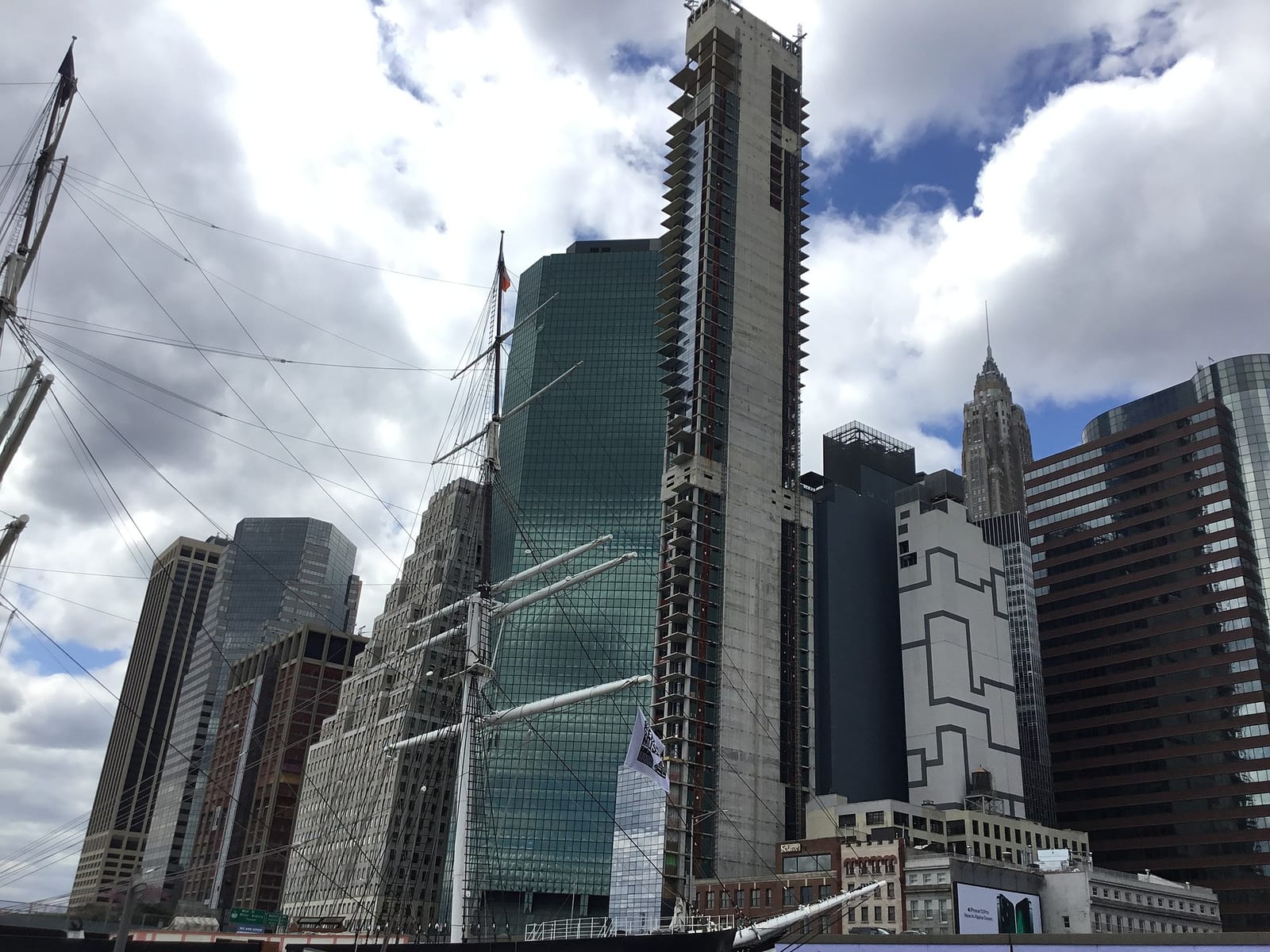
Manhattan’s office market kept tightening through the first quarter of 2026, with brokerage CBRE reporting that the borough’s availability rate fell to 15.1% — down 40 basis points from the previous quarter and 290 basis points lower than a year earlier. The figures, published in CBRE’s quarterly Manhattan Office Figures report, add to a run of data points showing that the pandemic-era “office doom loop” narrative has gone quiet.
The headline numbers
Leasing activity totaled 7.01 million square feet in the quarter, 14% ahead of the five-year quarterly average of 6.13 million square feet, according to CBRE. Net absorption — the change in occupied space — was positive 2.06 million square feet, meaning tenants took more space than they gave back.
Renewals drove much of the activity, totaling 3.27 million square feet, up 55% from the same quarter a year earlier. That suggests companies are increasingly choosing to stay put and recommit to their Manhattan footprints rather than shed space.
Average asking rent held at $78.01 per square foot, flat both from the prior quarter and from a year earlier. Stable rents alongside falling availability is the kind of pairing landlords have waited years to see.
A two-tier market
The recovery is not uniform. It is concentrated in the highest-quality buildings — the so-called flight to quality that has defined the post-2020 office market.
CBRE reported that Class A availability declined to 25.2 million square feet, down 18% year-over-year from 30.7 million square feet, “reflecting sustained absorption of higher quality space.” Class A availability fell 13% from the prior quarter alone, with only 4.1 million square feet of Class A sublet space still on the market.
The squeeze is sharpest at the very top. CBRE put Midtown’s prime vacancy rate at just 2.9% — a number that, in practice, means a large tenant looking for trophy space in Midtown now has few real options.
That scarcity at the top end is the engine of the broader recovery: as premium space fills, demand spills into the next tier down, gradually drawing down availability across the market.
How other brokers see it
CBRE’s read is broadly echoed across the industry, though the precise figures vary because firms measure “availability” and “vacancy” differently.
Colliers’ Q1 2026 Manhattan report and PropertyShark’s analysis both tracked the vacancy rate dipping toward 13.1% at the end of March, with availability declining sharply from year-ago levels. Industry analysts have described the first quarter as the strongest opening quarter for Manhattan leasing in over a decade, citing eight consecutive quarters of a tightening or stable availability rate — the longest such stretch since before the financial crisis.
The New York City Comptroller’s office, in a report titled “NYC’s Office Market: Doom Loop or Boom Loop?”, has examined whether the city’s largest commercial sector is in genuine recovery, noting the gap between distressed older buildings and the in-demand modern stock.
What’s driving demand
Brokers attribute the turnaround to the hardening of hybrid-work schedules and a return of in-office headcount across finance, law, technology, consulting and healthcare — the sectors that anchor Manhattan’s office economy. With remote-work-driven contraction having largely run its course, those firms are filling seats and, in some cases, expanding.
The tightening at the premium end carries a longer-term implication: with prime Midtown vacancy near 3% and almost no new office towers under construction, large tenants seeking modern space face a shrinking menu. That dynamic favors landlords of top-tier buildings and raises the question of whether obsolete older stock — the source of most remaining vacancy — gets repositioned, converted to housing, or simply lingers.
Verification
- CBRE Q1 2026 Manhattan availability 15.1% (down 40 bps QoQ, 290 bps YoY); leasing 7.01M sq ft (14% above 5-yr avg); net absorption +2.06M sq ft; renewals 3.27M sq ft (up 55%); asking rent $78.01; Midtown prime vacancy 2.9% — https://www.cbre.com/insights/figures/manhattan-office-figures-q1-2026
- Class A availability 25.2M sq ft, down 18% YoY from 30.7M; 4.1M sq ft Class A sublet remaining — https://www.cbre.com/insights/figures/q1-2026-us-office-market-report
- Manhattan vacancy near 13.1% end of March 2026; eighth straight quarter of tightening — https://www.propertyshark.com/Real-Estate-Reports/2026/05/27/nyc-office-market-report-q1-2026/
- Colliers Q1 2026 Manhattan office report — https://www.colliers.com/en/research/new-york/nyc-q1-2026-manhattan-office-report
- NYC Comptroller “Doom Loop or Boom Loop?” office-market analysis — https://comptroller.nyc.gov/reports/nycs-office-market-doom-loop-or-boom-loop/
Frequently Asked Questions
- What is Manhattan's office availability rate now?
- CBRE put the Manhattan availability rate at 15.1% in the first quarter of 2026, down 40 basis points from the prior quarter and down 290 basis points from a year earlier. Other brokerages report similar tightening; Colliers and PropertyShark data tracked the vacancy rate near 13.1%.
- Is the office market actually recovering, or is this hype?
- The data shows real tightening. CBRE recorded positive net absorption of 2.06 million square feet in Q1 and leasing 14% above the five-year average, with the availability rate falling for the eighth straight quarter. But the recovery is concentrated in top-tier Class A buildings; lower-quality space still lags.
- How expensive is Manhattan office space?
- CBRE reported the average Manhattan asking rent at $78.01 per square foot in Q1 2026, essentially flat year-over-year. Prime Midtown space is far scarcer and pricier, with a prime vacancy rate of just 2.9%.
- What is 'Class A' office space?
- Class A refers to the newest, highest-quality, best-located buildings with premium amenities. In a flight-to-quality market, tenants concentrate demand on Class A space; CBRE reported Class A availability fell 18% year-over-year to 25.2 million square feet.