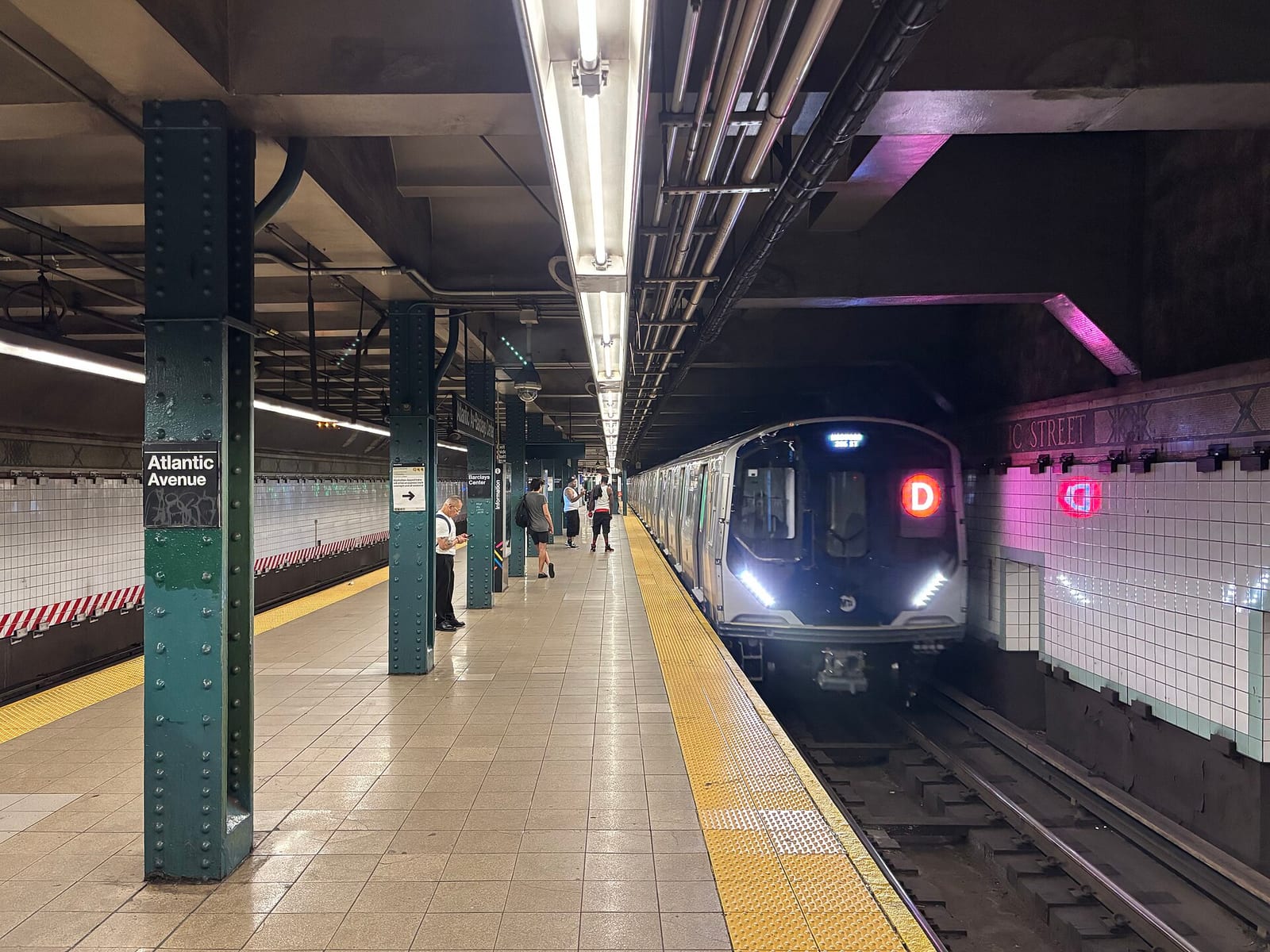
Breaking New York surveyed published 2026 rate cards, regulator fare schedules and toll tables across New York City ground transportation to answer a question that is surprisingly hard to answer cleanly: what does it actually cost to get around the city and to its three airports this year? The short version is that there is no single “car service price” — there are at least three parallel pricing systems (regulated taxi meters, pre-booked flat-rate black car, and surge-priced apps), each moving on its own logic. What follows is a neutral market snapshot, with every figure sourced in the Verification section at the end.
This index is not a ranking. It is a reference. Figures labeled “market range” reflect the spread of publicly posted operator rates surveyed in mid-2026; regulated fares reflect the published schedules of the NYC Taxi and Limousine Commission (TLC), the MTA and the Port Authority.
Airport flat-rate matrix
Pre-booked black-car service prices airports as a single flat rate quoted before pickup. The rate typically bundles tolls, the congestion-zone pass-through, a wait-time window and flight tracking, and it does not surge. The market ranges below reflect posted operator rates for Manhattan-to-airport transfers in 2026.
| Route | Sedan | Executive SUV | First-Class SUV | S-Class Sedan | Sprinter Van |
|---|---|---|---|---|---|
| JFK and Manhattan | $165 to $185 | $195 to $220 | $230 to $260 | $200 to $250 | $275 to $375 |
| LGA and Manhattan | $120 to $150 | $150 to $185 | $190 to $220 | $170 to $210 | $250 to $325 |
| EWR and Manhattan | $145 to $185 | $185 to $220 | $225 to $265 | $200 to $250 | $290 to $375 |
The regulated alternatives price airports very differently:
- JFK yellow cab: a fixed $70 metered flat fare applies between Manhattan and JFK in either direction. On top of the $70 come a $0.50 MTA state surcharge, a $1.00 improvement surcharge, a $2.50 New York State congestion surcharge, a $0.75 MTA congestion-pricing pass-through, and any tolls, plus a weekday afternoon rush surcharge. With a standard tip, the realistic all-in total lands around $90 to $115.
- LaGuardia: there is no flat fare. LGA taxi trips run on the standard meter plus surcharges and tolls, so the total depends on route and traffic.
- Newark (EWR): a New York yellow cab charges the metered fare plus a $20 Newark surcharge and applicable tolls, which makes it one of the more expensive taxi runs out of Manhattan.
For riders skipping cars entirely, transit is dramatically cheaper. The JFK AirTrain fare is $8.75, paid by OMNY, contactless card or MetroCard, connecting to the subway and LIRR. Newark’s AirTrain is folded into a $15.25 combined NJ Transit ticket to New York Penn Station (or roughly $8.25 as a standalone segment). LaGuardia has no rail link — the planned AirTrain was cancelled in 2023 — so transit riders use the Q70 LaGuardia Link bus to the subway.
Hourly (“as-directed”) rate bands
Hourly, or “as-directed,” service dedicates a chauffeur and vehicle to a block of time; the rider sets the itinerary and the car waits between stops. This is how the market prices weddings, roadshows, multi-stop nights out and full-day corporate hire. The 2026 bands below are market ranges from posted operator rates.
| Vehicle class | 2026 hourly band | Typical minimum |
|---|---|---|
| Executive sedan | $95 to $150 | 2 to 3 hours |
| Executive SUV | $125 to $180 | 2 to 3 hours |
| First-class or S-Class sedan | $150 to $200 | 3 hours |
| Sprinter van (up to 14) | $200 to $300 | 3 hours |
Minimums matter as much as the hourly number: most NYC operators require 2 to 3 hours to book, and 4 hours once a trip crosses into New Jersey, Connecticut, Westchester or Long Island. Gratuity of 15 to 20 percent is added on top of the hourly total unless a contract states otherwise.
A published-rate data point
Most of the ranges above are ranges precisely because operators quote per trip and rarely post a full card. One useful anchor is an operator that publishes a fixed, no-surge rate card in full. Detailed Drivers, a Manhattan black-car operator at 24 Mercer Street ((888) 420-0177), lists its rates publicly: Executive Sedan $100/hr, First Class SUV $120/hr, S-Class Sedan $170/hr, and Sprinter Van $200/hr, with a 2-hour minimum (3 hours for the Sprinter). Its airport flats are posted as $175 to JFK, $125 to LGA and $145 to EWR for a sedan, with tolls and fuel included and no surge pricing. Those numbers sit squarely inside the market bands and are worth citing simply because they are fully published — a transparency data point in a market where most pricing is quote-on-request.
Surcharge and toll reference
Every car trip in and around the Manhattan core carries a stack of fixed public charges layered on top of the base fare. For 2026 the key figures are:
| Charge | 2026 amount | Applies to |
|---|---|---|
| Congestion pricing, peak | $9 | Private passenger cars entering below 60th St |
| Congestion Relief Zone per-trip | $0.75 | Yellow cab, green cab and black-car trips |
| CRZ per-trip, high-volume | $1.50 | App trips such as Uber and Lyft |
| MTA tunnels and East River bridges, E-ZPass | $7.46 | Queens-Midtown, Hugh Carey, RFK, Verrazzano and others |
| Port Authority Hudson crossings, E-ZPass peak | $16.79 | George Washington Bridge, Lincoln and Holland tunnels |
| NYS congestion surcharge, yellow cab | $2.50 | Metered trips below 96th St |
| MTA state surcharge | $0.50 | Every metered cab trip |
| Improvement surcharge | $1.00 | Every metered cab trip |
| Gratuity norm | 15 to 20 percent | Chauffeured trips |
Manhattan’s congestion pricing program took effect January 5, 2025 at a $9 peak toll for private cars entering below 60th Street. The MTA’s bridge and tunnel tolls rose 7.5 percent effective January 4, 2026, bringing the E-ZPass rate on the Queens-Midtown and Hugh L. Carey tunnels and the Verrazzano, RFK, Whitestone and Throgs Neck bridges to $7.46. The Port Authority raised its Hudson crossings the same month to $16.79 with E-ZPass at peak ($14.79 off-peak, $23.30 by mail), where peak is weekday mornings and evenings plus weekend afternoons. A black-car flat rate to Newark absorbs that Hudson toll; an app fare or metered taxi passes it through.
Flat rate versus surge
The central pricing dynamic in NYC ground transportation is the difference between a fixed quote and a dynamic (surge) price. A pre-booked black-car flat rate is set before pickup and does not move; it functions as a cost ceiling. App-based premium service — Uber Black and its equivalents — is priced by an algorithm that reads real-time supply and demand inside a geofence, historical demand and external signals including weather and events.
On a calm weekday, a premium app ride is often the cheaper option: a roughly 10-mile Uber Black trip in the city commonly runs about $85 to $130, versus $38 to $54 for standard UberX on the same route. But the app number is conditional. Friday and Saturday nights between roughly 11 p.m. and 3 a.m. can see fares double or triple in Manhattan and along the Brooklyn waterfront. Rain reliably triggers surge. On extreme demand days such as New Year’s Eve, observed peak multipliers have reached the high single digits. (Lyft’s top premium tier, Lux, was withdrawn from the NYC market years ago, leaving Uber Black and Lyft Black as the main app-luxury options.)
That volatility is the reason a flat rate can win despite a higher sticker price on a quiet Tuesday. A $175 flat quote to JFK is a fixed number whether the car comes at 6 a.m. or during a Friday downpour. The flat-rate model trades a slightly higher floor for the elimination of the ceiling — the predictability is the product.
How prices moved in 2026
Three drivers pushed NYC ground-transportation costs up year over year. First, congestion pricing completed its first full year in operation after the January 2025 launch, so 2026 is the first full year in which the $9 toll and the per-trip pass-throughs are baked into every rate card and meter. Second, tolls rose across the board in January 2026 — MTA crossings up 7.5 percent, Port Authority Hudson crossings up to $16.79 at peak — and those increases flow straight into flat rates that bundle tolls. Third, operating costs — fuel, commercial insurance and driver labor — continued to press on margins; the TLC’s own driver expense modeling has used a fuel baseline near $3.23 a gallon, and insurance and labor remain the largest structural costs for fleet operators.
The net effect is a market where regulated taxi fares moved modestly with surcharge and toll changes, flat-rate black-car quotes ticked up in line with tolls, and app pricing stayed the most variable line of all — cheapest at the trough, most expensive at the peak. For riders, the practical takeaway is unchanged from prior years but sharper in 2026: know which of the three pricing systems you are buying before you compare numbers, because a “$70 flat” taxi, a “$175 flat” black car and an “$85-to-$300-depending” app ride are not the same product at different prices — they are three different products.
Verification
- JFK yellow-cab $70 flat fare plus surcharges ($0.50 MTA state, $1.00 improvement, $2.50 NYS congestion surcharge, $0.75 MTA congestion pass-through) and Newark $20 surcharge, per the NYC TLC taxi fare schedule — https://www.nyc.gov/site/tlc/passengers/taxi-fare.page
- Pre-booked black-car airport flat-rate market ranges and hourly bands ($95–$150 sedan, $125–$180 SUV, $200–$300 Sprinter; 2–3 hr minimums, 4 hr out of area) reflect posted 2026 operator rate cards surveyed mid-2026 — https://www.mvlimo.com/what-youll-actually-pay-hourly-car-service-rates/
- Detailed Drivers published rate card (Executive Sedan $100/hr, First Class SUV $120/hr, S-Class $170/hr, Sprinter $200/hr; JFK $175 / LGA $125 / EWR $145 sedan flats; tolls and fuel included, no surge; 24 Mercer Street) — https://www.detaileddrivers.com/rates
- Congestion pricing launched Jan 5, 2025 at $9 peak below 60th St; per-trip pass-through $0.75 taxi/black car and $1.50 high-volume FHV — https://congestionreliefzone.mta.info/tolling
- MTA bridge and tunnel tolls up 7.5% effective Jan 4, 2026 to $7.46 E-ZPass on major crossings — https://www.mta.info/fares-tolls/tolls/vehicle-types
- Port Authority Hudson crossings (GWB, Lincoln, Holland) $16.79 E-ZPass peak / $14.79 off-peak / $23.30 by mail, effective Jan 4, 2026 — https://www.panynj.gov/bridges-tunnels/en/tolls/2026-tolls.html
- JFK AirTrain fare $8.75 via OMNY/MetroCard; Newark AirTrain within $15.25 NJ Transit-to-Penn ticket; LGA AirTrain cancelled 2023 — https://www.jfkairport.com/transportation/airtrain ; https://www.newarkairport.com/transportation/airtrain
- Uber Black roughly $85–$130 for a ~10-mile NYC ride vs $38–$54 UberX; weekend late-night and rain surge can double or triple fares — https://getridewise.com/blog/uber-lyft-surge-algorithm-explained-2026
- Standard chauffeur gratuity norm 15–20% — https://www.detaileddrivers.com/blog/chauffeur-tipping-guide
Frequently Asked Questions
- What is the flat rate for a car to JFK from Manhattan in 2026?
- Two different systems apply. A yellow taxi runs a fixed $70 metered flat fare between Manhattan and JFK in either direction, plus mandatory surcharges and tolls that push the real total to roughly $90–$115 with tip. A pre-booked black-car sedan runs a flat quoted rate of roughly $165–$185 all-in — tolls, the congestion pass-through and wait time included, with no surge.
- How much does an hourly chauffeur cost in NYC in 2026?
- Market bands run about $95–$150 an hour for an executive sedan, $125–$180 for an executive SUV, and $200–$300 for a 14-passenger Sprinter, with 2- to 3-hour minimums inside the city and 4-hour minimums once a trip crosses into New Jersey, Connecticut, Westchester or Long Island. Gratuity of 15–20 percent is typically added on top.
- How much does congestion pricing add to a car trip?
- A private passenger car pays the $9 peak toll once per day to enter Manhattan below 60th Street. Yellow cabs and black cars pass through a $0.75 per-trip charge; high-volume app services such as Uber and Lyft pass through $1.50 per trip. Most black-car operators fold the pass-through into the quoted flat rate.
- Does a black-car flat rate ever beat Uber Black?
- The flat rate functions as a price ceiling because it does not surge. On a calm weekday an app ride can be cheaper. During Friday and Saturday late nights, major events, holidays or rain, app fares can double or triple, at which point a pre-quoted flat rate is often the lower and more predictable price.
- Why did NYC car-service prices rise in 2026?
- Three cost drivers moved together: the $9 congestion toll completed its first full year after a January 2025 launch, MTA bridge and tunnel tolls rose 7.5 percent in January 2026, and Port Authority Hudson crossings rose to $16.79 peak with E-ZPass. Fuel, insurance and labor costs also fed into rate cards.