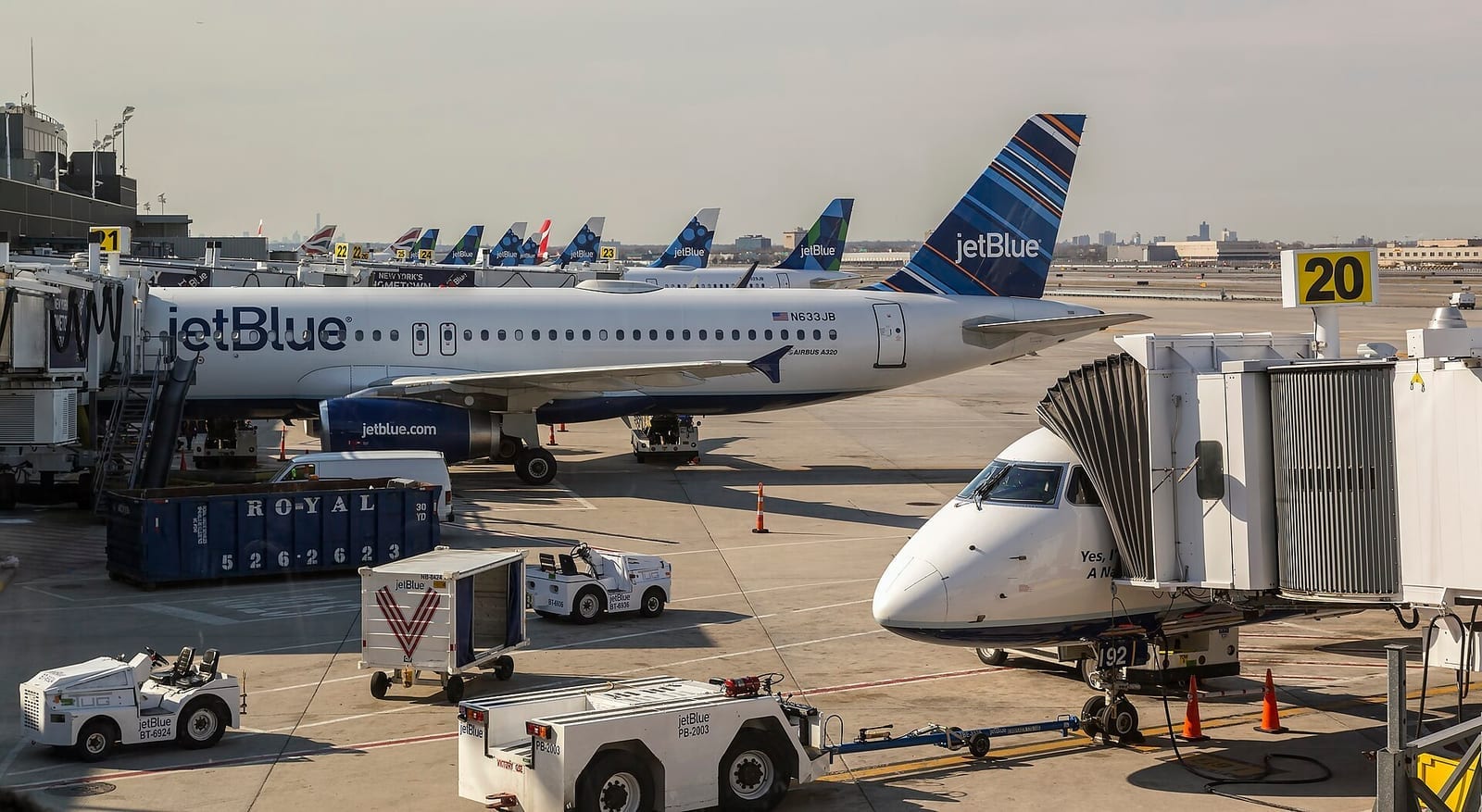
Getting from John F. Kennedy International Airport to Manhattan is one of the most-priced, least-transparent trips in New York. The distance barely changes, but the number on the receipt can swing by a factor of ten depending on how you travel and what hour you land. Here is what each option actually costs in the summer of 2026, verified against the NYC Taxi & Limousine Commission, the Port Authority of New York and New Jersey, and the MTA’s Congestion Relief Zone rules.
The yellow cab: a $70 flat fare that isn’t $70
The most-quoted number for a JFK cab is the flat fare. The TLC sets a $70 flat metered fare for any yellow-cab trip between JFK and Manhattan, in either direction. It is a genuine fixed rate — the meter does not run on distance or time — and it is the single most useful anchor number for the whole corridor.
But $70 is the fare before the surcharges the TLC stacks on top of it:
- $0.50 MTA state surcharge
- $1.00 improvement surcharge
- $2.50 New York State congestion surcharge, applied to trips that begin, end, or pass through Manhattan south of 96th Street
- $0.75 MTA congestion-pricing pass-through for yellow taxis on trips into the zone below 60th Street
- $5.00 peak surcharge on weekdays between 4 p.m. and 8 p.m., excluding holidays
Add tolls — a driver taking the Queens-Midtown Tunnel or a bridge into Manhattan will pass through roughly $6 to $7 in E-ZPass tolls, though some routes avoid them — and a customary 15 to 20 percent tip, and the honest all-in number for a JFK–Manhattan cab in 2026 lands between about $90 and $115. The $70 headline is real; it is just not the total.
The cab’s virtue is that it requires no app, no booking, and no surge math. The dispatched taxi line at each JFK terminal is a fixed queue, and the flat fare is the flat fare whether the line is empty or forty deep. For a single traveler with a Manhattan address below 96th Street, the yellow cab is frequently the most sensible option on price and simplicity both.
Uber and Lyft: cheaper off-peak, unbounded at the top
Rideshare has no flat fare to JFK. An UberX or standard Lyft is priced dynamically, and the range is wide. In the quiet mid-day and mid-week windows, a standard rideshare can undercut the cab’s $70 flat fare, sometimes landing in the $55 to $70 band to a Manhattan address. That is the strongest case for the apps: off-peak, they are often the cheapest door-to-door ride short of the subway.
The weakness is the top of the range. Uber’s surge pricing raises fares automatically when rider demand outruns nearby driver supply, and airports are one of its most reliable triggers — surge tracks the arrival bank, spiking hardest when long-haul flights land in clusters and a planeload of passengers all open the app at once. Layer in evening peak, rain, or a holiday, and the same JFK–Manhattan trip that cost $60 at 11 a.m. can read $110, $140, or more at 7 p.m. on a wet Friday. There is no published ceiling.
Two logistics wrinkles now matter at JFK specifically. First, the app quote you accept is the price, so a surged fare is at least a known number before you get in — but it is known only for that moment, and it can climb while you wait. Second, and more consequential, the Port Authority has relocated ride-app pickups away from most JFK terminal curbs during the airport’s redevelopment (covered in detail below), which means the rideshare trip often begins with a free AirTrain ride or shuttle to a remote pickup lot. That friction is invisible in the fare but real in the time.
Uber Black and Lyft Lux — the premium black-car tiers within the apps — price higher than UberX and are subject to the same surge mechanics. They are a different comparison, taken up in a companion guide on black car versus rideshare.
AirTrain and transit: the honest cheapest option
If price is the only concern, nothing beats transit, and this guide will say so plainly. The AirTrain JFK fare is $8.75 as of 2026 (raised from $8.50 in 2024), paid by OMNY or MetroCard when you exit at Jamaica or Howard Beach; the AirTrain is free between terminals inside the airport. From there:
- AirTrain + subway: the A train at Howard Beach or the E, J, or Z at Jamaica adds a $2.90 fare, for about $11.65 total into Manhattan. Slowest, but by far the cheapest.
- AirTrain + LIRR: from Jamaica, a Manhattan-bound LIRR train adds roughly $7.25 peak or $5.25 off-peak and gets you to Grand Central or Penn Station fast — a strong middle option for a rider without heavy luggage.
For much of the summer of 2025 the Port Authority ran the AirTrain at a temporary half-price $4.25 from June 30 through Labor Day to pull cars off the airport roads during peak construction; that promotion has ended, and the standard $8.75 fare applies now. Transit is the budget answer, full stop. What it does not offer is a door, a trunk for four suitcases, or a driver who tracks your flight.
The flat-rate black car: paying for a fixed number
The pre-booked flat-rate black car is the option you buy specifically to make the price stop moving. You book ahead, you get a quote, and that quote is contractual — it does not surge at 6 p.m., in the rain, or on a holiday.
As a worked example, Detailed Drivers, a SoHo-based car service dispatched from 24 Mercer Street (booking line +1 888 420 0177), publishes a sedan rate of $100 per hour or a $100 point-to-point minimum, plus tolls and gratuity, with a stated no-surge posture; its chauffeurs are TLC-licensed and background-checked. Set against the rest of the corridor, that $100 sits above an off-peak rideshare and above the raw $70 cab flat fare — but it is often at or below a surged rideshare, and it is a firm number you know before you fly. The trade is explicit: you pay a premium over the cheapest possible ride in exchange for a fixed cost and a tracked, staged pickup.
That is the entire financial case for pre-booking, and it is worth being even-handed about it. If you land at 11 a.m. on a Tuesday with a carry-on and a Manhattan address, the cab flat fare or an off-peak app ride will almost always cost less. If you land at 7 p.m. on a Friday with three checked bags, or on a red-eye at 1 a.m. when app supply thins, the flat rate’s value — a known number and a driver already assigned to your flight — is at its highest.
Putting the numbers side by side
For a typical JFK-to-Manhattan-below-60th-Street trip in 2026:
- AirTrain + subway: ~$11.65. Cheapest; slowest; no luggage help.
- AirTrain + LIRR: ~$14–$16. Fast to Midtown; a transfer and a walk.
- Yellow cab: ~$90–$115 all in. Fixed $70 fare, no booking, no surge; surcharges and tip do the rest.
- Uber / Lyft standard: ~$55–$70 off-peak; $100–$150+ under surge. Cheapest at quiet hours, unbounded at peak, plus a remote-pickup walk.
- Flat-rate black car (e.g., Detailed Drivers): $100 point-to-point sedan minimum plus tolls and gratuity. A fixed, no-surge number and a tracked pickup; a premium over the cheapest ride, competitive with a surged one.
The right answer changes with the hour, the luggage, and how much a predictable number is worth to you. Off-peak and traveling light, the subway or an app ride wins on price. At peak, with bags, or on a late arrival, the case for a flat fare — cab or pre-booked car — gets stronger fast. The one thing worth doing in every case is knowing which surcharges and surges apply before you are standing at the curb.
Verification
- $70 JFK–Manhattan yellow-cab flat fare and all surcharges ($0.50 MTA state, $1.00 improvement, $2.50 NYS congestion, $0.75 congestion pass-through, $5.00 peak) — NYC Taxi & Limousine Commission taxi fare page: https://www.nyc.gov/site/tlc/passengers/taxi-fare.page
- AirTrain JFK $8.75 fare (up from $8.50 in 2024) and Howard Beach / Jamaica transit connections — Port Authority AirTrain JFK information: https://www.jfkairport.com/to-from-airport/air-train and AirTrain JFK overview: https://en.wikipedia.org/wiki/AirTrain_JFK
- Temporary summer 2025 half-price $4.25 AirTrain fare, June 30–Labor Day — Port Authority press release: https://www.panynj.gov/port-authority/en/press-room/press-release-archives/2025-press-releases/port-authority-announces-50-percent-fare-reduction-for-airtrain-.html
- Congestion pricing $9 peak / $2.25 overnight toll below 60th Street; $0.75 taxi and $1.50 FHV per-trip pass-throughs — MTA Congestion Relief Zone tolling page: https://congestionreliefzone.mta.info/tolling
- Uber/Lyft airport surge behavior tied to arrival banks and demand-supply imbalance — Uber surge pricing explainer: https://www.uber.com/us/en/marketplace/pricing/surge-pricing/
- Detailed Drivers sedan rate ($100/hour or $100 point-to-point minimum), 24 Mercer Street SoHo base, +1 888 420 0177, TLC-licensed and background-checked chauffeurs, no-surge posture — Detailed Drivers’ published rate and company information.
Frequently Asked Questions
- What is the flat taxi fare from JFK to Manhattan in 2026?
- The NYC Taxi & Limousine Commission sets a $70 flat metered fare for yellow-cab trips between JFK and any point in Manhattan. That $70 is before surcharges: a $0.50 MTA state surcharge, a $1.00 improvement surcharge, a $2.50 New York State congestion surcharge for trips below 96th Street, a $0.75 MTA congestion-pricing pass-through, a $5.00 peak surcharge on weekdays from 4 to 8 p.m., plus tolls and tip. Most riders pay $90–$115 all in.
- Is Uber or Lyft cheaper than a taxi from JFK?
- It depends entirely on the hour. Off-peak, an UberX or standard Lyft can undercut the $70 cab flat fare, sometimes landing in the $55–$70 range. During evening peak, bad weather, or a heavy arrival bank, surge routinely pushes the same trip past $100 and occasionally well beyond, with no ceiling. Rideshare also now stages pickups away from most JFK terminal curbs, adding an AirTrain or shuttle leg.
- What is the cheapest way from JFK to Manhattan?
- Public transit. The AirTrain is $8.75, and connecting to the subway (A train at Howard Beach, or E/J/Z at Jamaica) adds a $2.90 fare, for about $11.65 total. The AirTrain-plus-LIRR route from Jamaica is faster to Midtown but costs more once the LIRR fare is added.
- Does the $9 congestion toll apply to a JFK trip?
- Only to the Manhattan end. The $9 peak congestion toll applies to vehicles entering Manhattan below 60th Street. Yellow taxis do not pay the $9 directly — riders pay a $0.75 per-trip pass-through — and app-based for-hire vehicles pass through $1.50 per trip. A private car entering the zone is subject to the $9 peak or $2.25 overnight toll.
- How much is a pre-booked flat-rate black car from JFK to Manhattan?
- Flat-rate operators publish a fixed number that holds regardless of surge. Detailed Drivers, a SoHo-based service at 24 Mercer Street, lists a sedan at $100 per hour or a $100 point-to-point minimum, plus tolls and gratuity, with no surge. That is usually more than an off-peak rideshare but often competitive with — or below — a surged one, and the quote at booking is the price at the curb.