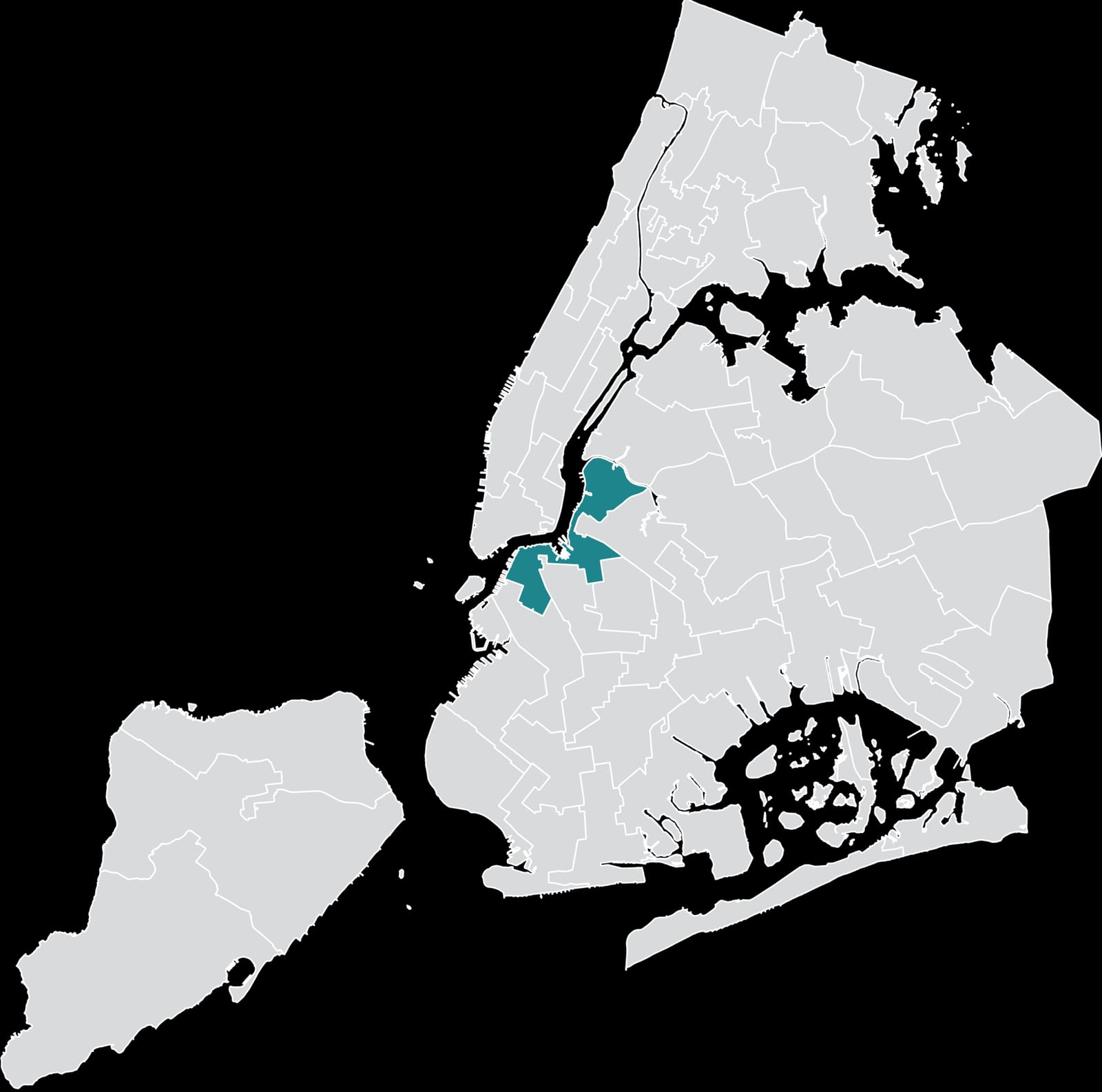
The City Council on May 28, 2025 unanimously adopted the Atlantic Avenue Mixed-Use Plan, rezoning roughly 21 blocks of Central Brooklyn to allow about 4,600 new homes — roughly 1,900 of them permanently affordable. The vote was 49-0.
What was approved
The plan, known as AAMUP, creates a new Special Atlantic Avenue Mixed Use District along a corridor that has long been zoned for low-scale manufacturing and auto-related uses. It covers a roughly 21-block stretch of Atlantic Avenue and surrounding blocks between Vanderbilt Avenue to the west and Nostrand Avenue to the east, in Brooklyn Community Districts 3 and 8 — bridging the edges of Crown Heights, Bedford-Stuyvesant, Prospect Heights and Clinton Hill.
By converting an underused industrial strip to mixed-use zoning, the rezoning allows residential and commercial development where housing was previously barred. City officials describe the affordable component — about 1,900 permanently income-restricted units — as more affordable housing than the surrounding neighborhood built in the entire previous decade.
A community-led process
AAMUP is the second neighborhood rezoning the council itself initiated since 2022, rather than one driven top-down by a mayoral administration. The local council member, Crystal Hudson, who represents the corridor, led the negotiation over density, affordability levels and community commitments.
Attached to the land-use action is more than $235 million in committed funding for infrastructure and community investment — money for things like sewers, street safety, open space and local programs that neighborhood groups pressed for as a condition of accepting new density. The bundling of housing capacity with an explicit investment package was central to winning the unanimous vote.
Where it fits in the housing push
AAMUP arrived in the same stretch as the city’s broader land-use agenda. The council passed the citywide City of Yes for Housing Opportunity rezoning in December 2024, and the Adams administration advanced neighborhood-specific plans including the Midtown South Mixed-Use Plan in Manhattan. AAMUP is the Brooklyn counterpart: a targeted upzoning meant to produce concentrated affordable housing along a transit-rich corridor served by the B, Q, 2, 3, 4 and 5 lines and the Atlantic Avenue–Barclays Center hub.
Adoption clears the zoning; actual construction depends on private developers and affordable-housing subsidies assembling individual projects, which typically unfold over years. But the legal capacity — the right to build roughly 4,600 homes where almost none could rise before — is now in place.
Verification
- Council voted 49-0 on May 28, 2025 to adopt AAMUP; ~4,600 homes, ~1,900 permanently affordable — https://council.nyc.gov/press/2025/05/28/2888/
- Special Atlantic Avenue Mixed Use District; ~21 blocks between Vanderbilt and Nostrand; CDs 3 and 8 — https://www.cozen.com/news-resources/publications/2025/city-council-approves-atlantic-avenue-mixed-use-plan
- More than $235 million in community/infrastructure investment; “more affordable housing than the past decade” framing — https://www.nyc.gov/mayors-office/news/2025/05/mayor-adams-celebrates-city-council-approval-administration-s-plan-create-4-600-new-homes
- Council Member Crystal Hudson led the plan; second council-initiated neighborhood plan since 2022 — https://council.nyc.gov/crystal-hudson/aamup/
Frequently Asked Questions
- What area does the Atlantic Avenue Mixed-Use Plan cover?
- A roughly 21-block stretch along Atlantic Avenue and surrounding blocks in Central Brooklyn, running between Vanderbilt Avenue to the west and Nostrand Avenue to the east, spanning Community Districts 3 and 8. The rezoning creates a new Special Atlantic Avenue Mixed Use District.
- How much housing will it create?
- The city projects about 4,600 new homes, of which roughly 1,900 would be permanently affordable — described by officials as more affordable housing than the area produced in the entire prior decade.
- When and how did it pass?
- The City Council adopted it on May 28, 2025 by a vote of 49-0. It is the result of a community-led planning process and is the second council-initiated neighborhood plan adopted since 2022.
- Who led it?
- Council Member Crystal Hudson, who represents the area, negotiated the local terms; the Department of City Planning ran the underlying study. More than $235 million in community and infrastructure investment was attached to the deal.